

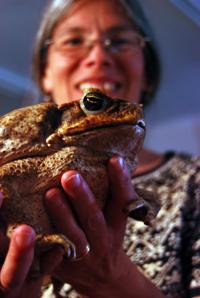
A cane toad from Suriname is helping Northern Arizona University researcher Kiisa Nishikawa understand the speed, power and energy behind the toad's ability to capture prey with its tongue. Her studies offer insight into how muscles function more as springs than motors. Credit: Photo by Danielle Borth A toad sits at a pond's edge eyeing a cricket on a blade of grass. In the blink of an eye, the toad snares the insect with its tongue. This deceptively simple, remarkably fast feeding action offers a new look at how muscles work.

| Biology | June 2, 2008 09:30 PM |
| Full story | 0 Comments | 6019 views |
| Biology | June 2, 2008 09:30 PM |
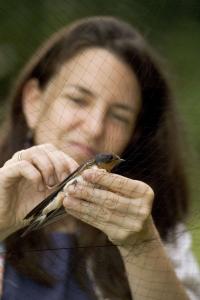
University of Colorado at Boulder Assistant Professor Rebecca Safran of the ecology and evolutionary biology department retrieves a North American barn swallow from a mist net for marking and release. A new study led by the University of Colorado at Boulder has shown the testosterone of male North American barn swallows skyrocketed early in the breeding season when their breast colors were artificially enhanced by researchers, indicating the clothes -- or in this case, the feathers -- make the man.
| Full story | 0 Comments | 7052 views |

| Biotechnology | June 2, 2008 09:30 PM |
Forensic scientists at the University of Leicester, working with Northamptonshire Police, have announced a major breakthrough in crime detection which could lead to hundreds of cold cases being reopened.
| Full story | 0 Comments | 9555 views |

| Molecular & Cell Biology | June 2, 2008 09:30 PM |
As the cost of sequencing a single human genome drops rapidly, with one company predicting a price of $100 per person in five years, soon the only reason not to look at your "personal genome" will be fear of what bad news lies in your genes.
| Full story | 0 Comments | 8089 views |

| Gene Therapy | June 2, 2008 09:30 PM |
A new approach to treating vision loss caused by Type 1 Usher syndrome (USH1), the most common condition affecting both sight and hearing, will be unveiled by a scientist at the annual conference of the European Society of Human Genetics tomorrow (Tuesday 3 June). Ms Annie Rebibo Sabbah, from the Genetics Department of the Rappaport Faculty of Medicine, Technion, Haifa, Israel, will tell the conference that preliminary results using a class of drugs called aminoglycosides, commonly used as antibiotics, had had promising effects in vitro and in cell culture.
| Full story | 0 Comments | 9893 views |
| Molecular & Cell Biology | June 2, 2008 12:17 PM |
What are the genes implicated in upright walking of humans? The discovery of four families in which some members only walk on all fours (quadrupedality) may help us understand how humans, unlike other primates, are able to walk for long periods on only two legs, a scientist will tell the annual conference of the European Society of Human Genetics tomorrow (Monday 2 June).
| Full story | 0 Comments | 8099 views |

| Environment | June 2, 2008 12:17 PM |
The Brown Argus butterfly Aricia agestis has expanded northwards in Britain during the last 30 years. It is thought that the recent expansion of the species is due to the increasing summer temperatures caused by global warming.
| Full story | 0 Comments | 6886 views |
| Biology | June 2, 2008 12:17 PM |
Forest management that favors single tree species and climate change are just two of the critical factors making forests throughout western North America more susceptible to infestation by bark beetles, according to an article published in the June 2008 BioScience. Bark beetle epidemics have become more extensive and frequent in recent years as winter temperatures have risen, and an eruption of mountain pine beetles is currently devastating lodgepole pines throughout the mountainous West.
| Full story | 0 Comments | 6765 views |

- In some genetic cases of microcephaly, stem cells fail to launch
- Yale team discovers how Zika virus causes fetal brain damage
- Scientists uncover the way a common cell enzyme alerts the body to invading bacteria
- Arctic gives clues on worst mass extinction of life
- Calcium channel blockers caught in the act at atomic level
Search Bio News Net
Free Biology Newsletter
- Flexibility That A.C.A. Lent to Work Force Is Threatened by...International Herald Tribune
- Bacteria Behind Legionnaires’ Disease Found at New York Police StationInternational Herald Tribune
- Prescription Price Crisis? 28 Million Americans See Spike in Drug...MSNBC.com: Health
- Seizing on Opioid Crisis, a Drug Maker Lobbies Hard for...International Herald Tribune
- Republicans are taking a big political risk on health careAP Health News
- Why We're So Divided Over Saving WolvesNational Geographic News