

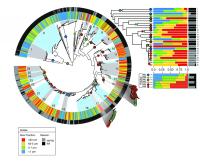
This figure shows the likely habitats of vibrio bacteria populations mapped onto a phylogenetic tree for all strains found in the samples taken from the Atlantic Ocean near Plum Island, Mass. Dot colors indicate the predicted habitat of the bacteria (red are believed to attach to zooplankton, yellow to large organic particles, green to small organic particles, and finally blue are free-floating). The outer ring indicates the microbe’s preference for warm weather (gray) or cold (black). The inner ring shows where the microbes were found (attached or free-floating). The 25 shaded bands within show the ecological populations based on habitat and genetic similarity, all of which originated from a common ancestor hundreds of millions of years ago. Populations 9 through 25 are all called V. splendidus, even though they have distinct habitat preferences and genetic lineage distributions. Two of those (15 and 17) appear to be in the process of radiating into a different habitat. Credit: Lawrence David and Dana Hunt, MIT Marine bacteria in the wild organize into professions or lifestyle groups that partition many resources rather than competing for them, so that microbes with one lifestyle, such as free-floating cells, flourish in proximity with closely related microbes that may spend life attached to zooplankton or algae.

| Microbiology | May 22, 2008 07:31 PM |
| Full story | 0 Comments | 6846 views |

| AIDS & HIV | May 22, 2008 07:31 PM |
Today, Advanced BioScience Laboratories, Inc. (ABL) and the University of Massachusetts Medical School (UMMS) report that their unique HIV vaccine formulation was effective in eliciting strong and balanced immune responses in healthy human volunteers. The findings are published in the journal Vaccine (“Cross-subtype antibody and cellular immune responses induced by a polyvalent DNA prime–protein boost HIV-1 vaccine in healthy human volunteers,” Vaccine online, May 22, 2008) In light of these initial findings, additional assays on volunteers’ samples were done by researchers at the University of Alabama at Birmingham, independently confirming the presence of long lasting and high quality T cell responses against HIV antigens. Results from this confirmatory study are currently available online in the Journal of Virology (April 30, 2008).
| Full story | 0 Comments | 5384 views |

| Molecular & Cell Biology | May 22, 2008 07:31 PM |
For the first time, researchers at Delft University of Technology have witnessed the spontaneous repair of damage to DNA molecules in real time. They observed this at the level of a single DNA molecule. Insight into this type of repair mechanism is essential as errors in this process can lead to the development of cancerous cells. Researchers from the Kavli Institute of Nanoscience Delft are to publish an article on this in the leading scientific journal Molecular Cell.
| Full story | 0 Comments | 5755 views |

| Biotechnology | May 22, 2008 07:31 PM |
A new technology with research and clinical application including the early detection of disease has been invented and developed by University of Queensland researchers.
| Full story | 0 Comments | 5720 views |

| Biology | May 22, 2008 07:31 PM |
U.S. Forest Service scientists with the Institute of Pacific Islands Forestry have submitted a proposal to release a Brazilian insect to control the spread of strawberry guava, a South American tree that has invaded and degraded native Hawaiían ecosystems since it was introduced in 1825 as a garden plant.
| Full story | 0 Comments | 7258 views |
| Molecular & Cell Biology | May 22, 2008 07:31 PM |
Insulin, a hormone released in large quantities when food is consumed, is reduced by 50% only three to five minutes later. However, if the cell’s internal waste disposal system malfunctions, illnesses such as Alzheimer’s or Parkinson’s disease may occur. To prevent this from happening, the complex process of protein degradation first needs to be fully understood at an atomic level so that appropriate drugs can be developed. Biochemists at Frankfurt University, collaborating with an international team of scientists have just taken an important step towards unravelling the workings of this mechanism. In the current edition of the scientific journal “Nature” they report finding the long-awaited receptor for ubiquitin on the proteasome. This receptor may well turn out to have a key role in fighting tumours.
| Full story | 0 Comments | 7310 views |
| Biology | May 22, 2008 07:31 PM |
22nd May 2008 – The first study to determine the global threat status of 21 species of wide-ranging oceanic pelagic sharks and rays reveals serious overfishing and recommends key steps that governments can take to safeguard populations. These findings and recommendations for action are published in the latest edition of Aquatic Conservation: Marine and Freshwater Ecosystems.
| Full story | 0 Comments | 24112 views |
| Molecular & Cell Biology | May 22, 2008 07:31 PM |
In our brains, where millions of signals move across a network of neurons like runners in a relay race, all the critical baton passes take place at synapses. These small gaps between nerve cell endings have to be just the right size for messages to transmit properly. Synapses that grow too large or too small are associated with motor and cognitive impairment, learning and memory difficulties, and other neurological disorders.
| Full story | 0 Comments | 7313 views |
| Molecular & Cell Biology | May 22, 2008 07:31 PM |
A new study by Duke University researchers provides more evidence that the nitric oxide (NO) system in the life of a cell plays a key role in disease, and the findings point to ways to improve treatment of illnesses such as heart disease and cancer.
| Full story | 0 Comments | 6043 views |
| Biology | May 22, 2008 12:41 AM |
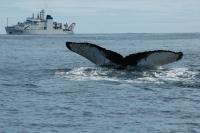
NOAA ship Oscar Dyson stands watch as researchers gather information from humpback whales. Humpback whale flukes, like the one shown here, are unique to each animal just like a fingerprint. This whale could be identified thousands of miles away by its distinctive markings. Credit: NOAA The number of humpback whales in the North Pacific Ocean has increased since international and federal protections were enacted in the 1960s and 70s, according to a new study funded primarily by NOAA and conducted by more than 400 whale researchers throughout the Pacific region.
| Full story | 0 Comments | 8839 views |
| Molecular & Cell Biology | May 22, 2008 12:41 AM |
New research by the Gladstone Institutes of Cardiovascular Disease (GICD) and the University of California, San Francisco (UCSF), has revealed the genetic determinants of fat storage in cells, which may lead to a new understanding of and potential treatments for obesity, diabetes, and heart disease. While scientists have long understood that lipid droplets contribute to fat build up in cells, the genes involved in droplet biology have been a focus of extensive research.
| Full story | 0 Comments | 6387 views |
| Molecular & Cell Biology | May 22, 2008 12:41 AM |
In an online paper in the journal Nature, Yale University researchers funded by the National Institute of Allergy and Infectious Diseases (NIAID), part of the National Institutes of Health, explain how a common ingredient in many vaccines stimulates and interacts with the immune system to help provide protection against infectious diseases.
| Full story | 0 Comments | 7143 views |
| Biology | May 22, 2008 12:41 AM |
There are only four specimens of the Yangtze giant softshell turtle left on Earth—one in the wild and three in captivity. In order to save this species from extinction, conservation partners from the Wildlife Conservation Society (WCS) and the Turtle Survival Alliance (TSA), working in conjunction with partners from two Chinese zoos and the China Zoo Society, recently paired two of them. A still reproductive, more than 80-year-old, female, living in China’s Changsha Zoo has been introduced to the only known male in China, a more than 100-year-old living more than 600 miles away at the Suzhou Zoo.
| Full story | 0 Comments | 7825 views |

| Stem Cell Research | May 22, 2008 12:41 AM |
Research from the University of Southern California (USC) has discovered a new mechanism to allow embryonic stem cells to divide indefinitely and remain undifferentiated. The study, which will be published in the May 22 issue of the journal Nature, also reveals how embryonic stem cell multiplication is regulated, which may be important in understanding how to control tumor cell growth.
| Full story | 0 Comments | 8094 views |
| Biology | May 22, 2008 12:41 AM |
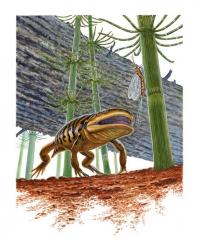
An Early Permian landscape, with Gerobatrachus hottoni lunging at the mayfly Protoreisma between stands of Calamites and under a fallen Walchia conifer. The description of an ancient amphibian that millions of years ago swam in quiet pools and caught mayflies on the surrounding land in Texas has set to rest one of the greatest current controversies in vertebrate evolution. The discovery was made by a research team led by scientists at the University of Calgary.
| Full story | 0 Comments | 5494 views |
| Biology | May 22, 2008 12:41 AM |
The brain centers triggered by a betrayal of trust have been identified by researchers, who found they could suppress such triggering and maintain trust by administering the brain chemical oxytocin. The researchers said their findings not only offer basic insights into the neural machinery underlying trust; the results may also help in understanding the neural basis of social disorders such as phobias and autism.
| Full story | 0 Comments | 5629 views |

- In some genetic cases of microcephaly, stem cells fail to launch
- Yale team discovers how Zika virus causes fetal brain damage
- Scientists uncover the way a common cell enzyme alerts the body to invading bacteria
- Arctic gives clues on worst mass extinction of life
- Calcium channel blockers caught in the act at atomic level
Search Bio News Net
Free Biology Newsletter
- Flexibility That A.C.A. Lent to Work Force Is Threatened by...International Herald Tribune
- Bacteria Behind Legionnaires’ Disease Found at New York Police StationInternational Herald Tribune
- Prescription Price Crisis? 28 Million Americans See Spike in Drug...MSNBC.com: Health
- Seizing on Opioid Crisis, a Drug Maker Lobbies Hard for...International Herald Tribune
- Republicans are taking a big political risk on health careAP Health News
- Why We're So Divided Over Saving WolvesNational Geographic News