


Biologists from Austria and Singapore developed a technique that adds a new twist on the relationship between biology and art. In an article recently published online in The FASEB Journal (http://www.fasebj.org) and scheduled for the August 2008 print issue, these researchers describe how they were able to coat—or paint—viruses with proteins.

| Molecular & Cell Biology | May 20, 2008 09:32 AM |
Researchers from the University of Melbourne, Australia, and the University of Texas, USA, have extracted genes from the extinct Tasmanian tiger (thylacine), inserted it into a mouse and observed a biological function – this is a world first for the use of the DNA of an extinct species to induce a functional response in another living organism.
| Full story | 0 Comments | 5786 views |
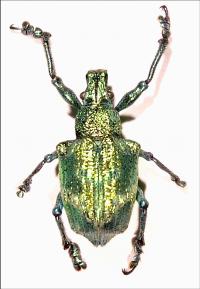
This inch-long beetle from Brazil accomplished a task that so far has stymied human researchers. University of Utah chemists determined the beetle glows iridescent green because it evolved a crystal structure in its scales that is like the crystal structure of diamonds. Such a structure is considered an ideal architecture for "photonic crystals" that will be needed to manipulate visible light in ultrafast optical computers of the future. Credit: Jeremy Galusha, University of Utah Researchers have been unable to build an ideal “photonic crystal” to manipulate visible light, impeding the dream of ultrafast optical computers. But now, University of Utah chemists have discovered that nature already has designed photonic crystals with the ideal, diamond-like structure: They are found in the shimmering, iridescent green scales of a beetle from Brazil.
| Full story | 0 Comments | 9008 views |

| Health & Medicine | May 20, 2008 09:30 AM |
Scientists at Saint Louis University have made two key discoveries that could lead to the first-ever human testing of a drug to target the adenovirus, which causes a number of severe upper-respiratory infections and is one of many viruses that causes the common cold.
| Full story | 0 Comments | 5287 views |

| Microbiology | May 20, 2008 09:30 AM |
It’s the case of the missing flu virus. When the flu isn’t making people sick, it seems to just vanish. Yet, every year, everywhere on Earth, it reappears in the appropriate season and starts its attack. So where does it go when it disappears? Does it hibernate, lying dormant in a few people and preparing for its next onslaught? Does it bounce around from the Northern hemisphere to the Southern hemisphere and back, following the seasons?
| Full story | 0 Comments | 5168 views |

| Biology | May 20, 2008 09:30 AM |
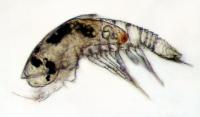
Y larvae. First identified in 1899, y-larvae have been one of the greatest zoological mysteries for over a century. No one has ever found an adult of these puzzling crustaceans, despite the plethora of these larvae in plankton, leading generations of marine zoologists to wonder just what y- larvae grow up to be. A study published in BioMed Central’s open access journal, BMC Biology, reports the transformation of the larvae into a previously unseen, wholly un-crustacean-like, parasitic form.
| Full story | 0 Comments | 7028 views |

- In some genetic cases of microcephaly, stem cells fail to launch
- Yale team discovers how Zika virus causes fetal brain damage
- Scientists uncover the way a common cell enzyme alerts the body to invading bacteria
- Arctic gives clues on worst mass extinction of life
- Calcium channel blockers caught in the act at atomic level
Search Bio News Net
Free Biology Newsletter
- Flexibility That A.C.A. Lent to Work Force Is Threatened by...International Herald Tribune
- Bacteria Behind Legionnaires’ Disease Found at New York Police StationInternational Herald Tribune
- Prescription Price Crisis? 28 Million Americans See Spike in Drug...MSNBC.com: Health
- Seizing on Opioid Crisis, a Drug Maker Lobbies Hard for...International Herald Tribune
- Republicans are taking a big political risk on health careAP Health News
- Why We're So Divided Over Saving WolvesNational Geographic News