


Carnegie Mellon University’s Justin Y. Newberg and Robert F. Murphy have developed a software toolbox that is intended to help bioscience researchers characterize protein patterns in human tissues.

| Health & Medicine | May 12, 2008 11:26 PM |
A mutated gene has been discovered as the key behind epilepsy and mental retardation specific to women, thanks to new research at Adelaide’s Women’s & Children’s Hospital and the University of Adelaide, Australia.
| Full story | 0 Comments | 7211 views |

| Biology | May 12, 2008 10:26 PM |
Losing a limb can be a traumatic experience and, in some cases, emotional and physical pain can linger for years. To better understand the phenomenon, dubbed “phantom limb syndrome,” Université de Montréal graduate student Emma Duerden is inviting amputees to come forward and share their experiences for a major study.
| Full story | 0 Comments | 6153 views |

| Molecular & Cell Biology | May 12, 2008 10:26 PM |
Fruit flies are dramatically different from humans not in their number of genes, but in the number of protein interactions in their bodies, according to scientists who have developed a new way of estimating the total number of interactions between proteins in any organism.
| Full story | 0 Comments | 6580 views |
| Molecular & Cell Biology | May 12, 2008 09:26 PM |
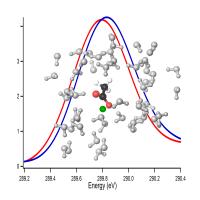
X-ray spectroscopy shows that a protein acetate group (molecule at center) prefers binding with sodium (blue curve) over potassium (red curve); the green sphere represents a cation, with surrounding water molecules in white. Credit: Lawrence Berkeley National Laboratory, figure by Janel Uejio In the late 19th century the Czech scientist Franz Hofmeister observed that some salts (ionic compounds) aided the solution of proteins in egg white, some caused the proteins to destabilize and precipitate, and others ranged in activity between these poles.
| Full story | 0 Comments | 5504 views |

| Microbiology | May 12, 2008 09:26 PM |
Why do parasites harm their hosts? Classic evolutionary theory predicts that parasites become more virulent because they must transmit themselves between hosts, yet scientists have found little data to support this idea, until now.
| Full story | 0 Comments | 5930 views |
| Biology | May 12, 2008 08:26 PM |
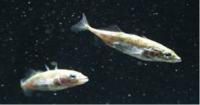
Follow that fish -- threespine sticklebacks that were used in the experiments. For animals that live in social groups, and that includes humans, blindly following a leader could place them in danger.
| Full story | 0 Comments | 5893 views |

| Stem Cell Research | May 12, 2008 08:26 PM |
While it has long been known that embryonic stem cells have the ability to develop into any kind of tissue-specific cells, the exact mechanism as to how this occurs has heretofore not been demonstrated. Now, researchers at the Hebrew University of Jerusalem and elsewhere have succeeded in graphically revealing this process, resolving a long-standing question as to whether the stem cells achieve their development through selective activation or selective repression of genes.
| Full story | 0 Comments | 5771 views |

- In some genetic cases of microcephaly, stem cells fail to launch
- Yale team discovers how Zika virus causes fetal brain damage
- Scientists uncover the way a common cell enzyme alerts the body to invading bacteria
- Arctic gives clues on worst mass extinction of life
- Calcium channel blockers caught in the act at atomic level
Search Bio News Net
Free Biology Newsletter
- Flexibility That A.C.A. Lent to Work Force Is Threatened by...International Herald Tribune
- Bacteria Behind Legionnaires’ Disease Found at New York Police StationInternational Herald Tribune
- Prescription Price Crisis? 28 Million Americans See Spike in Drug...MSNBC.com: Health
- Seizing on Opioid Crisis, a Drug Maker Lobbies Hard for...International Herald Tribune
- Republicans are taking a big political risk on health careAP Health News
- Why We're So Divided Over Saving WolvesNational Geographic News