


British and Canadian scientists expect to begin trials next month (May) to find out whether microbes can unlock the vast amount of energy trapped in the world's unrecoverable heavy oil deposits.

| Molecular & Cell Biology | April 29, 2008 10:18 PM |
Botulinum neurotoxin – responsible for the deadly food poisoning disease botulism and for the beneficial effects of smoothing out facial wrinkles – can also be used as a dreaded biological weapon. When ingested or inhaled, less than a billionth of an ounce can cause muscle paralysis and eventual death. Although experimental vaccines administered prior to exposure can inhibit the destructive action of this neurotoxin – the most deadly protein known to humans – no effective pharmacological treatment exists.
| Full story | 0 Comments | 8159 views |

| Biotechnology | April 29, 2008 09:18 PM |

Compounds from oilseeds could be used to make plastics and other products. Australian researchers are a step closer to turning plants into ‘biofactories’ capable of producing oils which can be used to replace petrochemicals used to manufacture a range of products.
| Full story | 0 Comments | 9192 views |

| Health & Medicine | April 29, 2008 08:18 PM |
Age at menopause may now be predicted more realistically according to a new study accepted for publication in the Journal of Clinical Endocrinology & Metabolism (JCEM). The study revealed that anti-Müllerian hormone (AMH) levels are related to the onset of menopause and are able to specify a woman’s reproductive age more accurately than chronological age alone.
| Full story | 0 Comments | 8643 views |

| Biology | April 29, 2008 07:18 PM |
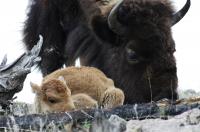
A bison and calf in Yellowstone National Park. Bison can repopulate large areas from Alaska to Mexico over the next 100 years provided a series of conservation and restoration measures are taken, according to continental assessment of this iconic species by the Wildlife Conservation Society and other groups. The assessment was authored by a diverse group of conservationists, scientists, ranchers, and Native Americans/First Nations peoples, and appears in the April issue of the journal Conservation Biology.
| Full story | 0 Comments | 8382 views |

| Environment | April 29, 2008 07:18 PM |
__IMAGE_2 Ancient Sunflower Fuels Debate About Agriculture in the Americas Researchers at the University of Cincinnati and Florida State University have confirmed evidence of domesticated sunflower in Mexico — 4,000 years before what had been previously believed.
| Full story | 0 Comments | 7341 views |
| Biology | April 29, 2008 06:18 PM |
Researchers discovered a legless lizard and a tiny woodpecker along with 12 other suspected new species in Brazil’s Cerrado, one of the world’s 34 biodiversity conservation hotspots.
| Full story | 0 Comments | 8880 views |
| Molecular & Cell Biology | April 29, 2008 05:18 PM |
CSIRO Entomology business manager, Cameron Begley, said researchers believed the discovery opened up an entirely new class of chemistry.
| Full story | 0 Comments | 6566 views |
| Biotechnology | April 29, 2008 01:56 AM |
Intravenous administration of isotonic fluids is the standard emergency treatment in the U.S. for patients with severe blood loss, but UC San Diego bioengineering researchers have reported improved resuscitation with a radically different approach. Building on earlier studies in humans that have shown benefits of intravenous fluids that are eight times saltier than normal saline, the researchers combined hypertonic saline with viscosity enhancers that thicken blood.
| Full story | 0 Comments | 8313 views |
| Health & Medicine | April 29, 2008 01:56 AM |
The key focus of the Diogenes study is to identify the most effective diet to help adults stop regaining weight after initial successful weight loss.
| Full story | 0 Comments | 7804 views |
| Biotechnology | April 29, 2008 01:56 AM |
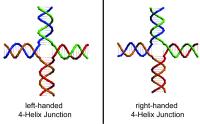
Biodesign Institute scientist John Chaput and his research team have made the first self-assembled nanostructures composed entirely of glycerol nucleic acid -- a synthetic analog of DNA. The nanostructures contain additional properties not found in natural DNA, including the ability to form mirror image structures. The ability to make mirror image structures opens up new possibilities for nanotechnology. Credit: Biodesign Institute at Arizona State University In the rapid and fast-growing world of nanotechnology, researchers are continually on the lookout for new building blocks to push innovation and discovery to scales much smaller than the tiniest speck of dust.
| Full story | 0 Comments | 7731 views |
| Biology | April 29, 2008 01:56 AM |
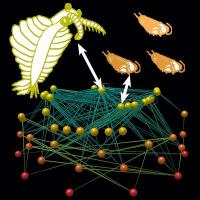
In this depiction of the food web of the Burgess Shale from the Middle Cambrian, spheres represent species or groups of species, and the links between them show feeding relationships. The drawing shows a top predator, Anomalocaris, chasing one of its likely prey species, the trilobite Olenoides, with arrows indicating their positions in the food web. Many aspects of the structure of this ancient ecological network are similar to the architecture of modern food webs.
Credit: Image: N. D. Martinez. Food web produced with Network3D software written by R. J. Williams It was an Anomalocaris-eat-trilobite world, filled with species like nothing on today's Earth. But the ecology of Cambrian communities was remarkably modern, say researchers behind the first study to reconstruct detailed food webs for ancient ecosystems. Their paper, published this week in the open-access journal PLoS Biology, suggests that networks of feeding relationships among marine species that lived hundreds of millions of years ago are remarkably similar to those of today.
| Full story | 0 Comments | 8539 views |

- In some genetic cases of microcephaly, stem cells fail to launch
- Yale team discovers how Zika virus causes fetal brain damage
- Scientists uncover the way a common cell enzyme alerts the body to invading bacteria
- Arctic gives clues on worst mass extinction of life
- Calcium channel blockers caught in the act at atomic level
Search Bio News Net
Free Biology Newsletter
- Flexibility That A.C.A. Lent to Work Force Is Threatened by...International Herald Tribune
- Bacteria Behind Legionnaires’ Disease Found at New York Police StationInternational Herald Tribune
- Prescription Price Crisis? 28 Million Americans See Spike in Drug...MSNBC.com: Health
- Seizing on Opioid Crisis, a Drug Maker Lobbies Hard for...International Herald Tribune
- Republicans are taking a big political risk on health careAP Health News
- Why We're So Divided Over Saving WolvesNational Geographic News