

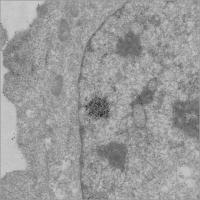
The new technique exposes living cells to labeled antibodies, an approach that yields a much stronger signal for electron microscopy. University of Illinois researchers have developed a technique for imaging cells under an electron microscope that yields a sharper image of the structure of chromatin, the tightly wound bundle of genetic material and proteins that makes up the chromosomes.

| Biotechnology | April 17, 2008 11:51 PM |
| Full story | 0 Comments | 8185 views |

| Biology | April 17, 2008 10:51 PM |
People who score high on intelligence tests are also good at keeping time, new Swedish research shows. The team that carried out the study also suspect that accuracy in timing is important to the brain processes responsible for problem solving and reasoning.
| Full story | 0 Comments | 6445 views |
| Biotechnology | April 17, 2008 09:51 PM |
New research demonstrates that novel probe technology based on flexible membranes can replace conventional atomic force microscopy (AFM) cantilevers for applications such as fast topographic imaging, quantitative material characterization and single molecule mechanics measurements.
| Full story | 0 Comments | 6956 views |
| Biology | April 17, 2008 08:51 PM |
When frogs hit the road, many croak.
Researchers found more than 65 animal species killed along a short stretch of roads in a Midwestern county. Nearly 95 percent of the total dead were frogs and other amphibians, suggesting that road-related death, or road-kill, possibly contributes to their worldwide decline, a trend that has concerned and puzzled scientists for decades.
| Full story | 0 Comments | 5983 views |

| Microbiology | April 17, 2008 07:51 PM |
Each winter, strains of influenza A virus infect North Americans, causing an average of 36,000 deaths. Now, researchers say the virus comes from a viral reservoir somewhere in the tropics, settling a key debate on the source of each season's infection.
| Full story | 0 Comments | 6909 views |
| Microbiology | April 17, 2008 06:51 PM |
Seasonal influenza strains constantly evolve in overlapping epidemics in Asia and sweep the rest of the world each year, an international research team has found.
| Full story | 0 Comments | 5946 views |

| Molecular & Cell Biology | April 17, 2008 05:51 PM |
Using a lowly bloodless worm, University of Maryland researchers have discovered an important clue to how iron carried in human blood is absorbed and transported into the body. The finding could lead to developing new ways to reduce iron deficiency, the world’s number one nutritional disorder.
| Full story | 0 Comments | 6762 views |
| Microbiology | April 17, 2008 04:51 PM |
Salmonella are wily and obnoxious bacterial invaders--escape artists capable of evading multiple immune responses and causing a harsh and debilitating intestinal infection.
| Full story | 0 Comments | 6200 views |
| Biology | April 17, 2008 02:51 PM |
Deep-sea sharks have been tagged and tracked and their habitats precisely mapped in world-first research to test the conservation value of areas closed to commercial fishing. Last month scientists from the CSIRO Wealth from Oceans National Research Flagship fitted acoustic tags to 50 gulper sharks, swellsharks and green eye dogfish near Port Lincoln, South Australia.
| Full story | 0 Comments | 6373 views |

| Health & Medicine | April 17, 2008 12:51 PM |
Researchers at The University of Texas Medical School at Houston say a crucial decision on whether to give intensive care to extremely premature infants should not be solely based on the infant’s gestational age.
| Full story | 0 Comments | 4908 views |

| Environment | April 17, 2008 10:51 AM |
The Wildlife Conservation Society (WCS) and the International Institute for Geo-Information Science and Earth have developed a new scientific model that accurately maps where coral reefs are in the most trouble and identifies regions where reefs can be protected best. The model, which is being applied in areas throughout the Indian Ocean, is described in a recent issue of the UK-based journal Ecological Modelling.
| Full story | 0 Comments | 5548 views |

- In some genetic cases of microcephaly, stem cells fail to launch
- Yale team discovers how Zika virus causes fetal brain damage
- Scientists uncover the way a common cell enzyme alerts the body to invading bacteria
- Arctic gives clues on worst mass extinction of life
- Calcium channel blockers caught in the act at atomic level
Search Bio News Net
Free Biology Newsletter
- Flexibility That A.C.A. Lent to Work Force Is Threatened by...International Herald Tribune
- Bacteria Behind Legionnaires’ Disease Found at New York Police StationInternational Herald Tribune
- Prescription Price Crisis? 28 Million Americans See Spike in Drug...MSNBC.com: Health
- Seizing on Opioid Crisis, a Drug Maker Lobbies Hard for...International Herald Tribune
- Republicans are taking a big political risk on health careAP Health News
- Why We're So Divided Over Saving WolvesNational Geographic News