

A small RNA molecule, known as let-7 microRNA (miRNA), substantially reduced cancer growth in multiple mouse models of lung cancer, according to work by researchers at Yale University and Asuragen, Inc., published in the journal Cell Cycle.

| Molecular & Cell Biology | March 20, 2008 10:36 PM |
Researchers at the Joslin Diabetes Center have shown that insulin has a previously unknown effect that plays a role in aging and lifespan, a finding that could ultimately provide a mechanism for gene manipulations that could help people live longer and healthier lives.
| Full story | 0 Comments | 5504 views |

| Biology | March 20, 2008 10:36 PM |

Mei Xiang, the female giant panda at the Smithsonian's National Zoo, was artificially inseminated March 19 by a team of Zoo scientists and veterinarians. The decision to perform the procedure was made after no successful mating had occurred between Mei Xiang and the Zoo's adult male panda Tian Tian. Timing was critical since giant pandas have one breeding season per year lasting only 24 to 48 hours. If the insemination is successful, the female panda is expected to give birth in the next 90 to 185 days. Credit: Jessie Cohen/Smithsonian’s National Zoo The 2008 giant panda mating season began Tuesday, March 18, at the Smithsonian's National Zoo. Female Mei Xiang (may-SHONG) and male Tian Tian (tee-YEN tee-YEN) attempted to mate throughout the day Tuesday.
| Full story | 0 Comments | 9162 views |

| Gene Therapy | March 20, 2008 10:36 PM |
By injecting a customized "genetic patch" into early stage fish embryos, researchers at Washington University School of Medicine in St. Louis were able to correct a genetic mutation so the embryos developed normally.
| Full story | 0 Comments | 10703 views |
| Biology | March 20, 2008 04:17 PM |

The first handbones found of the ancient Hadropithecus lemur reveal a mystery arch by the little finger. Analysis of the first hand bones belonging to an ancient lemur has revealed a mysterious joint structure that has scientists puzzled.
| Full story | 0 Comments | 7152 views |

| Biotechnology | March 20, 2008 02:17 PM |
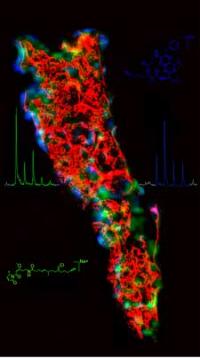
A thin section of marine sponge is highlighted with red indicating the presence of cyanobacteria and algae living within the the sponge and blue and green areas revealed by MALDI-TOF MS imaging as areas of organic compounds detected by this approach. Credit: UC San Diego With the number of terrestrial sources that yield novel treatments for human disease decreasing year by year, the oceans have been tapped as a promising resource for discovering new natural biomedicines. Two studies by scientists at UC San Diego, each utilizing mass spectrometry in novel ways, have helped narrow the gap in identifying potent natural compounds from the sea that could one day treat diseases such as cancer. The research, published in the journals Proceedings of the National Academy of Sciences (PNAS) and Molecular Biosystems, was led by research groups headed by William Gerwick of the Center for Marine Biotechnology and Biomedicine at Scripps Institution of Oceanography at UC San Diego and the UCSD Skaggs School of Pharmacy and Pharmaceutical Sciences, and Pieter Dorrestein of the UCSD Skaggs School.
| Full story | 0 Comments | 5817 views |
| Molecular & Cell Biology | March 20, 2008 12:17 PM |
Being too brainy can be a bad thing in a junior high cafeteria, where the social hierarchy favors other traits. "Braininess" also causes problems for cells. When a breast cell begins making the proteins normally produced in neurons, for example, it can acquire cancerous properties.
| Full story | 0 Comments | 4480 views |

| AIDS & HIV | March 20, 2008 10:17 AM |
Determining how the HIV/AIDS epidemic increases food insecurity in African cities – and what can be done to reduce the chances of this happening –is the focus of a new, international Queen’s-led project.
| Full story | 0 Comments | 5148 views |

- In some genetic cases of microcephaly, stem cells fail to launch
- Yale team discovers how Zika virus causes fetal brain damage
- Scientists uncover the way a common cell enzyme alerts the body to invading bacteria
- Arctic gives clues on worst mass extinction of life
- Calcium channel blockers caught in the act at atomic level
Search Bio News Net
Free Biology Newsletter
- Flexibility That A.C.A. Lent to Work Force Is Threatened by...International Herald Tribune
- Bacteria Behind Legionnaires’ Disease Found at New York Police StationInternational Herald Tribune
- Prescription Price Crisis? 28 Million Americans See Spike in Drug...MSNBC.com: Health
- Seizing on Opioid Crisis, a Drug Maker Lobbies Hard for...International Herald Tribune
- Republicans are taking a big political risk on health careAP Health News
- Why We're So Divided Over Saving WolvesNational Geographic News