

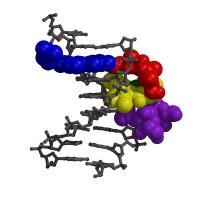
The image shows bleomycin represented in a space-filling rendering bound to DNA, in a gray ball-and-stick rendering. The color scheme highlights the different moieties that make up bleomycin: blue, bithiazole; red, linker; yellow, metal-binding domain; purple, dissacharide; and green, Co (III). Credit: Kristie Goodwin, Ph.D., Indiana University School of Medicine Researchers from the Indiana University School of Medicine and the Purdue School of Science at Indiana University-Purdue University Indianapolis have created the first three-dimensional image of how a well-established chemotherapy agent targets and binds to DNA. The study, which publishes online the week of March 17 in the Early Edition of the Proceedings of the National Academy of Sciences, may help scientists develop better chemotherapy drugs to treat a wide range of cancers.

| Molecular & Cell Biology | March 18, 2008 11:16 PM |
| Full story | 0 Comments | 5354 views |
| Molecular & Cell Biology | March 18, 2008 10:16 PM |
New findings about a protein called the nogo receptor are offering fresh ways to think about keeping the brain sharp.
| Full story | 0 Comments | 6868 views |

| Stem Cell Research | March 18, 2008 09:16 PM |
Scientists at Schepens Eye Research Institute have discovered what chemical in the eye triggers the dormant capacity of certain non-neuronal cells to transform into progenitor cells, a stem-like cell that can generate new retinal cells. The discovery, published in the March issue of Investigative Ophthalmology and Visual Science (IOVS), offers new hope to victims of diseases that harm the retina, such as macular degeneration and retinitis pigmentosa.
| Full story | 0 Comments | 24717 views |

| Biotechnology | March 18, 2008 08:16 PM |
In large-scale field trials, scientists from North Carolina State University have shown that silencing a specific gene in burley tobacco plants significantly reduces harmful carcinogens in cured tobacco leaves.
| Full story | 0 Comments | 7469 views |

| Health & Medicine | March 18, 2008 07:16 PM |
Individuals who experience military combat obviously endure extreme stress, and this exposure leaves many diagnosed with the psychiatric condition of post-traumatic stress disorder, or PTSD. PTSD is associated with several abnormalities in brain structure and function. However, as researcher Roger Pitman explains, “Although it is tempting to conclude that these abnormalities were caused by the traumatic event, it is also possible that they were pre-existing risk factors that increased the risk of developing PTSD upon the traumatic event’s occurrence.” Drs. Kasai and Yamasue along with their colleagues sought to examine this association in a new study published in the March 15th issue of Biological Psychiatry.
| Full story | 0 Comments | 8907 views |
| Health & Medicine | March 18, 2008 06:16 PM |
For years, scientists have been proclaiming the benefits of exercise. Studies showing that regular exercise benefits human health have exploded in number, examining many health problems ranging from cancer and diabetes to arthritis and pre-mature death.
| Full story | 0 Comments | 4817 views |

| Microbiology | March 18, 2008 05:16 PM |
The canine influenza virus, first identified in 2004, had been circulating in the greyhound population for at least five years prior to its discovery and may have been responsible for numerous outbreaks of respiratory disease among dogs at racing tracks during that period, according to research presented today (March 18) at the 2008 International Conference on Emerging Infectious Diseases in Atlanta, Georgia.
| Full story | 0 Comments | 6239 views |

| AIDS & HIV | March 18, 2008 02:57 PM |
Scientists have known for more than a decade that a protein associated with the HIV virus is good at crossing cell membranes, but they didn’t know how it worked. A multidisciplinary team from the University of Illinois has solved the mystery, and their findings could improve the design of therapeutic agents that cross a variety of membrane types.
| Full story | 0 Comments | 6449 views |
| Health & Medicine | March 18, 2008 12:57 PM |
Most people who suffer severe infection with West Nile virus still experience symptoms years after infection and many may continue to experience these symptoms for the rest of their lives according to research presented today (March 17) at the 2008 International Conference on Emerging Infectious Diseases in Atlanta, Georgia.
| Full story | 0 Comments | 5164 views |

| Biology | March 18, 2008 10:57 AM |
Clovis-age natives, often noted for overhunting during their brief dominance in a primitive North America, deserve clemency in the case of California's flightless sea duck. New evidence says it took thousands of years for the duck to die out.
| Full story | 0 Comments | 4521 views |

- In some genetic cases of microcephaly, stem cells fail to launch
- Yale team discovers how Zika virus causes fetal brain damage
- Scientists uncover the way a common cell enzyme alerts the body to invading bacteria
- Arctic gives clues on worst mass extinction of life
- Calcium channel blockers caught in the act at atomic level
Search Bio News Net
Free Biology Newsletter
- Flexibility That A.C.A. Lent to Work Force Is Threatened by...International Herald Tribune
- Bacteria Behind Legionnaires’ Disease Found at New York Police StationInternational Herald Tribune
- Prescription Price Crisis? 28 Million Americans See Spike in Drug...MSNBC.com: Health
- Seizing on Opioid Crisis, a Drug Maker Lobbies Hard for...International Herald Tribune
- Republicans are taking a big political risk on health careAP Health News
- Why We're So Divided Over Saving WolvesNational Geographic News