


A gene which helps a harmless African butterfly ward off predators by giving it wing patterns like those of toxic species, has been identified by scientists who publish their findings today (20 February 2008).

| Biotechnology | February 20, 2008 10:29 PM |
New findings show that a specialized virus with the ability to reproduce its tumor-killing genes can selectively target tumors in the brains of mice and eliminate them. Healthy brain tissue remained virtually untouched, according to a Feb. 20 report in The Journal of Neuroscience. With more research, the technique could one day offer a novel way of treating brain cancer in humans.
| Full story | 0 Comments | 8371 views |

| Molecular & Cell Biology | February 20, 2008 09:29 PM |
Researchers at Dana-Farber Cancer Institute have found a previously unknown molecular pathway in mice that spurs the growth of new blood vessels when body parts are jeopardized by poor circulation.
| Full story | 0 Comments | 8056 views |
| Molecular & Cell Biology | February 20, 2008 08:29 PM |
Understanding the structure of proteins involved in inhibiting HIV-1 infection could help in the battle against AIDS, and University of Minnesota researchers have taken a crucial step in that direction.
| Full story | 0 Comments | 5255 views |

| Bioinformatics | February 20, 2008 07:29 PM |
University of Michigan scientists and their colleagues at the National Institute on Aging have produced the largest and most detailed worldwide study of human genetic variation, a treasure trove offering new insights into early migrations out of Africa and across the globe.
| Full story | 0 Comments | 5914 views |

| Stem Cell Research | February 20, 2008 06:29 PM |
Neural cells derived from human embryonic stem cells helped repair stroke-related damage in the brains of rats and led to improvements in their physical abilities, according to a new study by researchers at the Stanford University School of Medicine.
| Full story | 0 Comments | 7949 views |

| Health & Medicine | February 20, 2008 05:29 PM |
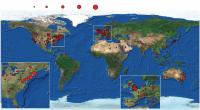
Global richness map of the geographic origins of EID events from 1940 to 2004. The map is derived for EID events caused by all pathogen types. Circles represent one degree grid cells, and the area of the circle is proportional to the number of events in the cell. Credit: Jones et. al., Nature It’s not just your imagination. Providing the first-ever definitive proof, a team of scientists has shown that emerging infectious diseases such as HIV, Severe Acute Respiratory Syndrome (SARS), West Nile virus and Ebola are indeed on the rise. The team – including University of Georgia professor John Gittleman and scientists from the Consortium for Conservation Medicine, the Institute of Zoology (London) and Columbia University – recently published their findings in leading scientific journal Nature.
| Full story | 0 Comments | 7248 views |
| Health & Medicine | February 20, 2008 05:29 PM |
The American Cancer Society’s annual cancer statistics report finds that death rates from cancer in the United States have decreased by 18.4 percent among men and by 10.5 percent among women since mortality rates began to decline in the early 1990s, which translates to the avoidance of more than half a million actual cancer deaths (534,500) in the United States. Society epidemiologists predict that in the U.S. in 2008 there will be 1,437,180 new cancer cases (745,180 in men and 692,000 in women) and 565,650 cancer deaths (294,120 among men and 271,530 among women).
| Full story | 0 Comments | 6188 views |

- In some genetic cases of microcephaly, stem cells fail to launch
- Yale team discovers how Zika virus causes fetal brain damage
- Scientists uncover the way a common cell enzyme alerts the body to invading bacteria
- Arctic gives clues on worst mass extinction of life
- Calcium channel blockers caught in the act at atomic level
Search Bio News Net
Free Biology Newsletter
- Flexibility That A.C.A. Lent to Work Force Is Threatened by...International Herald Tribune
- Bacteria Behind Legionnaires’ Disease Found at New York Police StationInternational Herald Tribune
- Prescription Price Crisis? 28 Million Americans See Spike in Drug...MSNBC.com: Health
- Seizing on Opioid Crisis, a Drug Maker Lobbies Hard for...International Herald Tribune
- Republicans are taking a big political risk on health careAP Health News
- Why We're So Divided Over Saving WolvesNational Geographic News