

It's hard to study a creature when you only catch fleeting glimpses of it. Up until recently, that was one of the big stumbling blocks for marine biologists and ecologists, but advances in electronic tracking technology have allowed them to peer farther across, and deeper under, the surface of the oceans than ever before.

| Molecular & Cell Biology | February 18, 2008 10:06 PM |
Researchers have taken the first steps toward understanding how an enzyme repairs DNA.
| Full story | 0 Comments | 7484 views |

| Biotechnology | February 18, 2008 09:06 PM |
Transgenic cotton cultivars were planted on almost 93% of U.S. cotton acres in 2007. Transgenic cultivars with pest-managing traits are dual-purpose products. The cultivars produce lint and seed, while the expressed propriety traits provide part of the crop’s insect management and/or enable use of broad-spectrum herbicides for weed management.
| Full story | 0 Comments | 7169 views |
| Biotechnology | February 18, 2008 08:06 PM |
By blasting a person's breath with laser light, scientists from the National Institute of Standards and Technology and the University of Colorado at Boulder have shown that they can detect molecules that may be markers for diseases like asthma or cancer.
| Full story | 0 Comments | 6767 views |

| Environment | February 18, 2008 07:06 PM |
Protected forest strips buffering rivers and streams of the Amazon rainforest should be significantly wider than the current legal requirement, according to pioneering new research by scientists at the University of East Anglia (UEA).
| Full story | 0 Comments | 4973 views |
First wind turbines on Galapagos Islands will halve diesel imports, reduce risk of future oil spills |
| Environment | February 18, 2008 06:06 PM |
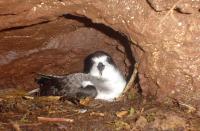
Galapagos Petrel In January 2001, the world held its breath when the tanker Jessica, loaded with 150,000 gallons of fuel, struck a reef and began breaking up in the heart of one of the most precious, famous and fragile ecosystems on earth – the Galapagos Islands.
| Full story | 1 Comment | 7539 views |

| Health & Medicine | February 18, 2008 04:44 PM |
When you check into a hospital, the odds are one in ten that you will become infected with a strain of antibiotic-resistant bacteria as a result of your stay. That is because the problem of drug-resistance has become endemic in today’s hospitals despite the best efforts of the medical profession. In the United States alone this currently causes about 100,000 deaths per year.
| Full story | 0 Comments | 4370 views |

| Biology | February 18, 2008 03:44 PM |
Shedding new light on the great cognitive rift between humans and animals, a Harvard University scientist has synthesized four key differences in human and animal cognition into a hypothesis on what exactly differentiates human and animal thought.
| Full story | 0 Comments | 8294 views |
| Environment | February 18, 2008 02:44 PM |
As oceans warm and become more acidic, ocean creatures are undergoing severe stress and entire food webs are at risk, according to scientists at a press briefing this morning at the annual meeting of the American Association for the Advancement of Science in Boston.
| Full story | 0 Comments | 7790 views |
| Biology | February 18, 2008 12:44 PM |
Sharks are disappearing from the world’s oceans. The numbers of many large shark species have declined by more than half due to increased demand for shark fins and meat, recreational shark fisheries, as well as tuna and swordfish fisheries, where millions of sharks are taken as bycatch each year.
| Full story | 0 Comments | 11975 views |
| Biology | February 18, 2008 10:44 AM |
The world’s sharks are disappearing. These fearsome yet charismatic fish continue to fall victim to overfishing and many are now at risk of extinction as a result. New research shows that open-ocean sharks are particularly threatened from overfishing, and other work shows that the deeper sharks live, the longer it takes for their populations to recover. Yet researchers are just now learning critical details of their behavior, including the fact that some species migrate quickly along “superhighway” routes and congregate at established “stepping stone” sites.
| Full story | 0 Comments | 7100 views |

- In some genetic cases of microcephaly, stem cells fail to launch
- Yale team discovers how Zika virus causes fetal brain damage
- Scientists uncover the way a common cell enzyme alerts the body to invading bacteria
- Arctic gives clues on worst mass extinction of life
- Calcium channel blockers caught in the act at atomic level
Search Bio News Net
Free Biology Newsletter
- Flexibility That A.C.A. Lent to Work Force Is Threatened by...International Herald Tribune
- Bacteria Behind Legionnaires’ Disease Found at New York Police StationInternational Herald Tribune
- Prescription Price Crisis? 28 Million Americans See Spike in Drug...MSNBC.com: Health
- Seizing on Opioid Crisis, a Drug Maker Lobbies Hard for...International Herald Tribune
- Republicans are taking a big political risk on health careAP Health News
- Why We're So Divided Over Saving WolvesNational Geographic News