


Using nanotechnology, scientists from UCLA and Northwestern University have developed a localized and controlled drug delivery method that is invisible to the immune system, a discovery that could provide newer and more effective treatments for cancer and other diseases.

| Microbiology | January 22, 2008 10:37 PM |
University of Navarra PhD in chemistry researcher, Esther Vicente, has discovered new compounds active for treating tuberculosis and malaria. Her thesis, defended at the Faculty of Sciences in her home city of Pamplona, the capital of Navarre, describes the synthesis and characterisation of 65 derivatives of quinoxaline, the structure of which is similar to a number of antimalalarial and antituberculosis pharmaceutical drugs currently on the market. Of the molecules prepared, four stand out for their antimalalarial activity and 15 for their antituberculosis activity.
| Full story | 0 Comments | 5500 views |
| Microbiology | January 22, 2008 09:37 PM |
Scientists studying microbial communities and the growth of sedimentary rock at Mammoth Hot Springs in Yellowstone National Park have made a surprising discovery about the geological record of life and the environment.
| Full story | 0 Comments | 6186 views |

| Health & Medicine | January 22, 2008 08:37 PM |
Block the action of a protein that normally regulates muscle mass, and watch your muscles grow.
| Full story | 0 Comments | 6775 views |
| Health & Medicine | January 22, 2008 07:37 PM |
(BRONX, NY) – For nearly three decades, Americans have become accustomed to hearing about the latest dietary guidelines, which are required by federal regulation to be revised and reissued at five-year intervals. Mid-way to the drafting of the 2010 guidelines, researchers at Albert Einstein College of Medicine of Yeshiva University raise questions about the benefits of federal dietary guidelines, and urge that guideline writers be guided by explicit standards of evidence to ensure the public good. The researchers, led by Paul Marantz, M.D., MPH, associate dean for clinical research education at Einstein, outline their argument in the January 22 online edition of the American Journal of Preventive Medicine.
| Full story | 1 Comment | 5548 views |
| Health & Medicine | January 22, 2008 06:37 PM |
In an appropriate prelude to American Heart Month, which is just ahead in February, new mortality data from the Centers for Disease Control and Prevention (CDC) shows that, since 1999, coronary heart disease and stroke age-adjusted death rates are down by 25.8 percent and 24.4 percent, respectively. This means that the American Heart Association’s 2010 strategic goal for reducing deaths from coronary heart disease has been achieved, and for stroke nearly achieved – ahead of time. However, potential problems loom for the future, as all of the major risk factors for these leading causes of death are still too high and several are actually on the rise. If this trend continues, death rates could begin to rise again in years ahead.
| Full story | 0 Comments | 5804 views |
| Microbiology | January 22, 2008 04:40 PM |
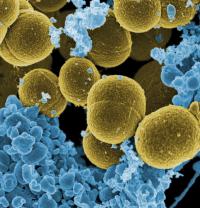
S. aureus bacteria escaping destruction by human white blood cells Community-associated methicillin-resistant Staphylococcus aureus (CA-MRSA) infections are caused primarily by a single strain—USA300—of an evolving bacterium that has spread with “extraordinary transmissibility” throughout the United States during the past five years, according to a new study led by National Institutes of Health (NIH) scientists. CA-MRSA, an emerging public health concern, typically causes readily treatable soft-tissue infections such as boils, but also can lead to life-threatening conditions that are difficult to treat.
| Full story | 0 Comments | 8189 views |
| Health & Medicine | January 22, 2008 02:40 PM |
A preliminary study suggests that melanomas have a different appearance than other irregular skin moles (i.e., are “ugly ducklings”), according to a report in the January issue of Archives of Dermatology, one of the JAMA/Archives journals.
| Full story | 0 Comments | 5816 views |
| Microbiology | January 22, 2008 12:40 PM |
The deadly Ebola virus, an emerging public health concern in Africa and a potential biological weapon, ranks among the most feared of exotic pathogens.
| Full story | 0 Comments | 5789 views |

| Biology | January 22, 2008 10:40 AM |
Denizens of oceans, lakes and even wet soil, diatoms are unicellular algae that encase themselves in intricately patterned, glass-like shells. Curiously, these tiny phytoplankton could be harboring the next big breakthrough in computer chips.
| Full story | 0 Comments | 6244 views |

- In some genetic cases of microcephaly, stem cells fail to launch
- Yale team discovers how Zika virus causes fetal brain damage
- Scientists uncover the way a common cell enzyme alerts the body to invading bacteria
- Arctic gives clues on worst mass extinction of life
- Calcium channel blockers caught in the act at atomic level
Search Bio News Net
Free Biology Newsletter
- Flexibility That A.C.A. Lent to Work Force Is Threatened by...International Herald Tribune
- Bacteria Behind Legionnaires’ Disease Found at New York Police StationInternational Herald Tribune
- Prescription Price Crisis? 28 Million Americans See Spike in Drug...MSNBC.com: Health
- Seizing on Opioid Crisis, a Drug Maker Lobbies Hard for...International Herald Tribune
- Republicans are taking a big political risk on health careAP Health News
- Why We're So Divided Over Saving WolvesNational Geographic News