


In an article published in the January 16 issue of PLoS ONE, Joan B. Company and colleagues at the Institut de Ciències del Mar (CSIC) in Spain describe a mechanism of interaction across ecosystems showing how a climate-driven phenomenon originated in shelf environments controls the biological processes of a deep-sea living resource.

| Biotechnology | January 16, 2008 04:09 PM |
A team of researchers headed by an environmental engineer at Washington University in St. Louis is plying new techniques to produce a biofuel superior to ethanol.
| Full story | 0 Comments | 6483 views |

| Microbiology | January 16, 2008 03:09 PM |
A potentially fatal species of malaria is being commonly misdiagnosed as a more benign form of the disease, thereby putting lives at risk, according to research funded by the Wellcome Trust and the University Malaysia Sarawak.
| Full story | 0 Comments | 7427 views |
| Microbiology | January 16, 2008 02:09 PM |
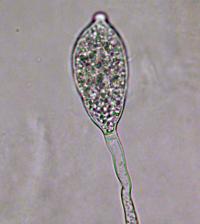
This photo shows the case or sporangium that contains Phytophthora infestans spores. A Virginia Tech plant pathologist known for his investigation of microbial life in the lower atmosphere is using unmanned aerial vehicles (UAVs) in a new, three-year study to detect, monitor, and forecast the spread of a fungus-like organism responsible for the Irish Potato Famine in the 1840s and 1850s. This famine resulted in the deaths of more than 1 million people in Ireland and caused at least 1.5 million more to flee the country.
| Full story | 0 Comments | 7404 views |

| Biology | January 16, 2008 01:09 PM |
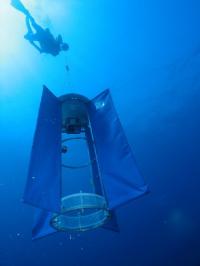
How tiny coral reef fish larvae locate the reef habitat across vast expanses of water has remained an enduring mystery. An innovative observational tool, the OWNFOR (Orientation With No Frame Of Reference) designed by UM Rosenstiel School researchers, is breaking new ground by allowing scientists to detect and quantify the orientation of larval coral reef fish in the pelagic environment; an often pitch black void with little or no frame of reference to navigate. Credit: Evan D'Alessandro One of the most significant questions facing marine ecologists today, is just how much of an impact global variations in the environment are having on the dispersal of larval and juvenile marine species from open oceans to coral reefs. Previously, tracking how fish larvae migrate was done through direct observation by divers on older larvae found near the reefs, after they’d spent weeks to months in the plankton. This method did not permit divers to follow small larvae, diving larvae or larvae as they returned to the reefs at night. How tiny coral reef fish larvae locate the reef habitat across vast expanses of water has remained an enduring mystery.
| Full story | 0 Comments | 9135 views |

| Molecular & Cell Biology | January 16, 2008 12:09 PM |
All multicellular animals have an innate immune system: When bacteria, parasites or fungi invade the organism, small protein molecules are released that eliminate the attackers. Scientists of the German Cancer Research Center (Deutsches Krebsforschungszentrum, DKFZ) have now discovered a new molecule that plays an important role in triggering the innate immune response of the fruit fly Drosophila, mice and even humans. Their work has just been published in the journal Nature Immunology.
| Full story | 0 Comments | 5090 views |

- In some genetic cases of microcephaly, stem cells fail to launch
- Yale team discovers how Zika virus causes fetal brain damage
- Scientists uncover the way a common cell enzyme alerts the body to invading bacteria
- Arctic gives clues on worst mass extinction of life
- Calcium channel blockers caught in the act at atomic level
Search Bio News Net
Free Biology Newsletter
- Flexibility That A.C.A. Lent to Work Force Is Threatened by...International Herald Tribune
- Bacteria Behind Legionnaires’ Disease Found at New York Police StationInternational Herald Tribune
- Prescription Price Crisis? 28 Million Americans See Spike in Drug...MSNBC.com: Health
- Seizing on Opioid Crisis, a Drug Maker Lobbies Hard for...International Herald Tribune
- Republicans are taking a big political risk on health careAP Health News
- Why We're So Divided Over Saving WolvesNational Geographic News