

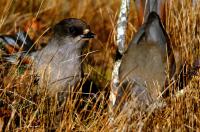
A male Siberian jay eats with his progeny, which makes the young bird's life much safer. With the aid of various alarm calls the Siberian jay bird species tells other members of its group what their main predators-¬hawks¬-are doing. The alarm calls are sufficient for Siberian jays to evince situation-specific fleeing behaviors, which enhances their chances of survival. This discovery, being published by Uppsala University researcher Michael Griesser in the journal Current Biology, shows for the first time that animals can assess and communicate about the behavior of predators.

| Biology | January 9, 2008 07:51 PM |
| Full story | 0 Comments | 7630 views |

| Molecular & Cell Biology | January 9, 2008 06:50 PM |
Researchers have identified a specific group of microRNA molecules that are responsible for controlling genes that cause breast cancer metastasis. The study, led by scientists at Memorial Sloan-Kettering Cancer Center (MSKCC), appears in the January 10, 2008, issue of Nature.
| Full story | 0 Comments | 8892 views |

| Microbiology | January 9, 2008 05:50 PM |
One of the most common human parasites, Toxoplasma gondii, uses a hormone lifted from the plant world to decide when to increase its numbers and when to remain dormant, researchers at Washington University School of Medicine in St. Louis have found.
| Full story | 0 Comments | 6713 views |
| Biology | January 9, 2008 04:50 PM |
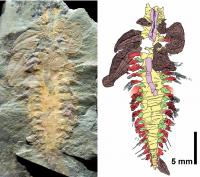
Fossil (left) and depiction (right) of extinct armored machaeridian worm. Colors indicate the trunk (yellow), limb (red), bristles (gray), attachment of shell plates (green), gut (purple) and dorsal linear structure (blue) Credit: Vinther, et al Nature Discovery of an exceptional fossil specimen in southeastern Morocco that preserves evidence of the animal’s soft tissues has solved a paleontological puzzle about the origins of an extinct group of bizarre slug-like animals with rows of mineralized armor plates on their backs, according to a paper in Nature.
| Full story | 0 Comments | 6883 views |
| Biology | January 9, 2008 03:50 PM |
Brain scans of hypnotized people that are taken as they forget and are triggered to remember have revealed neural circuitry that is key to the memory suppression and recall process. The researchers who conducted the study said their insights into the memory suppression and recall process may yield insight into the mechanisms underlying amnesia.
| Full story | 0 Comments | 7571 views |

- In some genetic cases of microcephaly, stem cells fail to launch
- Yale team discovers how Zika virus causes fetal brain damage
- Scientists uncover the way a common cell enzyme alerts the body to invading bacteria
- Arctic gives clues on worst mass extinction of life
- Calcium channel blockers caught in the act at atomic level
Search Bio News Net
Free Biology Newsletter
- Flexibility That A.C.A. Lent to Work Force Is Threatened by...International Herald Tribune
- Bacteria Behind Legionnaires’ Disease Found at New York Police StationInternational Herald Tribune
- Prescription Price Crisis? 28 Million Americans See Spike in Drug...MSNBC.com: Health
- Seizing on Opioid Crisis, a Drug Maker Lobbies Hard for...International Herald Tribune
- Republicans are taking a big political risk on health careAP Health News
- Why We're So Divided Over Saving WolvesNational Geographic News