

If the human body were a stage, then proteins would rank among the lead actors in the play we call “Life.”

| Molecular & Cell Biology | January 8, 2008 10:37 PM |
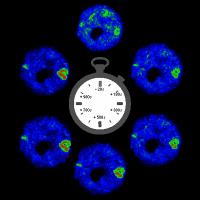
Watching genes turn on: Multiphoton microscopy images of living cells show the transcriptional activation of heat shock loci in real time. The molecular machinery behind gene transcription -- the intricate transfer of information from a segment of DNA to a corresponding strand of messenger RNA -- isn't stationed in special "transcription factories" within a cell nucleus, according to Cornell researchers. Instead, the enzyme RNA polymerase II (Pol II) and other key molecules can assemble at the site of an activated gene, regardless of the gene's position.
| Full story | 0 Comments | 4974 views |

| Environment | January 8, 2008 09:37 PM |
Coral reefs in the Caribbean have suffered significant changes due to the proximal effects of a growing human population, reports a study published in the Proceedings of the Royal Society of London, B.
| Full story | 0 Comments | 5025 views |

| Health & Medicine | January 8, 2008 08:37 PM |
Sub-Saharan Africa has been experiencing phenomenal population growth since the beginning of the XXth Century, following several centuries of population stagnation attributable to the slave trade and colonization. The region’s population in fact increased from 100 million in 1900 to 770 million in 2005. The latest United Nations projections, published in March 2007, envisaged a figure of 1.5 to 2 billion inhabitants being reached between the present and 2050.
| Full story | 0 Comments | 6466 views |
| Health & Medicine | January 8, 2008 07:37 PM |
The field of schizophrenia research has come alive with many exciting new potential approaches to treatment. From the introduction of chlorpromazine to the current day, all treatments approved by the U.S. Food and Drug Administration have had, at their core, a single treatment mechanism, the blockade of the dopamine D2 receptor. The introduction of clozapine in the 1980’s suggested a potential that other brain targets might complement the blockade of dopamine D2 receptors to treat symptoms that failed to respond to the “typical” antipsychotics. We are now entering an age where new treatments are being rationally developed within the context of translational neuroscience, i.e., the steps whereby basic molecular neuroscience leads to fundamental new mechanisms that can be tested in animal and human laboratory-based research that, in turn, leads to tests of new medications in our clinics. The January 1st issue of Biological Psychiatry includes encouraging new research related to three new treatment approaches.
| Full story | 0 Comments | 6265 views |
| Health & Medicine | January 8, 2008 06:37 PM |
Researchers at UT Southwestern Medical Center are uncovering how brain cells are affected in Fragile X syndrome, the most common cause of inherited mental retardation and the most common genetic cause of autism.
| Full story | 0 Comments | 6372 views |
| Health & Medicine | January 8, 2008 06:37 PM |
A disease most Americans have never heard of could soon become more prevalent if dengue, a flu-like illness that can turn deadly, continues to expand into temperate climates and increase in severity, according to a new commentary by Anthony S. Fauci, M.D., director of the National Institute of Allergy and Infectious Diseases (NIAID), part of the National Institutes of Health, and David M. Morens, M.D., Fauci’s senior scientific advisor. Their commentary appears in the January 9 and 16 double issue of the Journal of the American Medical Association.
| Full story | 0 Comments | 6932 views |
| Molecular & Cell Biology | January 8, 2008 06:37 PM |
Breast cancer risk varies widely among women who are carriers of the BRCA1 and BRCA2 mutations, according to a new study published in the January 9, 2008, issue of the Journal of the American Medical Association (JAMA).
| Full story | 0 Comments | 6583 views |
| Health & Medicine | January 8, 2008 06:37 PM |
The United States places last among 19 countries when it comes to deaths that could have been prevented by access to timely and effective health care, according to new research supported by The Commonwealth Fund and published in the January/February issue of Health Affairs. While other nations dramatically improved these rates between 1997–98 and 2002–03, the U.S. improved only slightly.
| Full story | 0 Comments | 5485 views |

- In some genetic cases of microcephaly, stem cells fail to launch
- Yale team discovers how Zika virus causes fetal brain damage
- Scientists uncover the way a common cell enzyme alerts the body to invading bacteria
- Arctic gives clues on worst mass extinction of life
- Calcium channel blockers caught in the act at atomic level
Search Bio News Net
Free Biology Newsletter
- Flexibility That A.C.A. Lent to Work Force Is Threatened by...International Herald Tribune
- Bacteria Behind Legionnaires’ Disease Found at New York Police StationInternational Herald Tribune
- Prescription Price Crisis? 28 Million Americans See Spike in Drug...MSNBC.com: Health
- Seizing on Opioid Crisis, a Drug Maker Lobbies Hard for...International Herald Tribune
- Republicans are taking a big political risk on health careAP Health News
- Why We're So Divided Over Saving WolvesNational Geographic News