


View of the inside of a plaster cast of the skull of the newly discovered young male Homo erectus from western Turkey. The stylus points to tiny lesions 1-2 mm in size found along the rim of bone just behind the right eye orbit. The lesions were formed by a type of tuberculosis that infects the brain and, at 500,000 years in age, represents the most ancient case of TB known in humans. Credit: Marsha Miller, the University of Texas at Austin Although most scientists believe tuberculosis emerged only several thousand years ago, new research from The University of Texas at Austin reveals the most ancient evidence of the disease has been found in a 500,000-year-old human fossil from Turkey.

| Health & Medicine | December 8, 2007 06:31 PM |
| Full story | 0 Comments | 7739 views |

| Microbiology | December 8, 2007 05:31 PM |
Researchers at the University of Texas Medical Branch have discovered how a key protein switch allows Chikungunya Virus (CHIKV) to spread to new vectors. The study, published December 7 in PLoS Pathogens, explains how the virus has increased its ability to infect and be transmitted by the Asian tiger mosquito, Aedes albopictus.
| Full story | 0 Comments | 6510 views |
| Health & Medicine | December 8, 2007 04:31 PM |
A new UC Davis study shows that a common antibacterial chemical added to bath soaps can alter hormonal activity in rats and in human cells in the laboratory—and does so by a previously unreported mechanism.
| Full story | 0 Comments | 7013 views |

| Molecular & Cell Biology | December 8, 2007 02:31 PM |
Alcohol triggers the activation of a variety of genes that can influence the health and activity of brain cells, and new research from Weill Cornell Medical College in New York City sheds light on how that process occurs.
| Full story | 0 Comments | 10719 views |

| Biotechnology | December 8, 2007 12:31 PM |
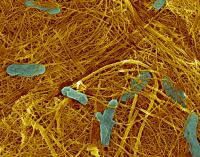
Shewanella bacteria (shown in blue) forming nanotubes. Two engineers at the University of California, Riverside are part of a binational team that has found semiconducting nanotubes produced by living bacteria – a discovery that could help in the creation of a new generation of nanoelectronic devices.
| Full story | 0 Comments | 6241 views |
| Microbiology | December 8, 2007 10:31 AM |
New research identifies a previously unknown enzymatic mechanism that subverts the early host immune response and promotes pathogenicity by manipulating a common signaling pathway in host cells. The research, published by Cell Press in the December 14th issue of Molecular Cell, may have important implications for the food industry and for development of new antibiotics. In addition, the results lead to intriguing questions about whether mammalian cells can make use of a similar mechanism for potentially permanent and irreversible posttranslational modifications.
| Full story | 0 Comments | 6339 views |

- In some genetic cases of microcephaly, stem cells fail to launch
- Yale team discovers how Zika virus causes fetal brain damage
- Scientists uncover the way a common cell enzyme alerts the body to invading bacteria
- Arctic gives clues on worst mass extinction of life
- Calcium channel blockers caught in the act at atomic level
Search Bio News Net
Free Biology Newsletter
- Flexibility That A.C.A. Lent to Work Force Is Threatened by...International Herald Tribune
- Bacteria Behind Legionnaires’ Disease Found at New York Police StationInternational Herald Tribune
- Prescription Price Crisis? 28 Million Americans See Spike in Drug...MSNBC.com: Health
- Seizing on Opioid Crisis, a Drug Maker Lobbies Hard for...International Herald Tribune
- Republicans are taking a big political risk on health careAP Health News
- Why We're So Divided Over Saving WolvesNational Geographic News