


Advances in sensing technologies have made exquisite measurements of brain activity possible in the past decade. Using these measurements, computer scientists will now help neuroscientists discover the complex neuronal networks in the brain that result in the actions we take for granted, like reaching for a glass of water.

| AIDS & HIV | November 15, 2007 10:24 PM |
A recent study of men co-infected with herpes simplex virus type 2 (HSV-2) and HIV revealed that drugs used to suppress HSV decrease the levels of HIV in the blood and rectal secretions, which may make patients less likely to transmit the virus. This study is published in the November 15 issue of the Journal of Infectious Diseases, now available online.
| Full story | 0 Comments | 6925 views |

| Biology | November 15, 2007 08:24 PM |
A 110 million-year-old dinosaur that had a mouth that worked like a vacuum cleaner, hundreds of tiny teeth and nearly translucent skull bones will be unveiled Thursday, Nov. 15, at the National Geographic Society.
| Full story | 0 Comments | 6936 views |

| Microbiology | November 15, 2007 04:33 PM |
A team of Princeton scientists has discovered a key mechanism in how bacteria communicate with each other, a pivotal breakthrough that could lead to treatments for cholera and other bacterial diseases.
| Full story | 0 Comments | 8100 views |

| Environment | November 15, 2007 02:33 PM |
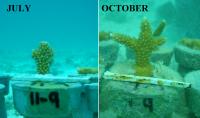
Fragment of staghorn coral illustrates the fast re-growth of the species between July and October 2007. In response to the need for localized efforts to protect and recover the surviving populations of the threatened staghorn coral, Diego Lirman, Ph.D., and James Herlan, researchers from the University of Miami’s Rosenstiel School of Marine and Atmospheric Science (RSMAS) have established an underwater nursery dedicated to the propagation of staghorn corals.
| Full story | 0 Comments | 7294 views |

| Health & Medicine | November 15, 2007 12:33 PM |
Rapid responses by Turkey's health authorities and key health personnel were critical in bringing the 2006 bird flu outbreak under control, according to research published in the online open access journal, BMC Public Health. Those involved cite poverty and families sharing their homes with poultry as factors behind the virus' transfer to humans.
| Full story | 0 Comments | 6027 views |
| Biology | November 15, 2007 11:33 AM |
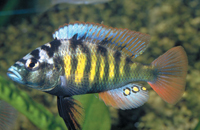
Cichild fish fighting and fishing. A gene has been found in male cichlid fish that evolved to lure female fish so that male cichlids can deposit sperm in the females mouths. A study in the online open access journal BMC Biology reveals that the gene is associated with egg-like markings on the fins of cichlid fishes and uncovers the evolutionary history of these markings, which are central to the success of the fishes' exotic oral mating behaviour.
| Full story | 0 Comments | 9590 views |

- In some genetic cases of microcephaly, stem cells fail to launch
- Yale team discovers how Zika virus causes fetal brain damage
- Scientists uncover the way a common cell enzyme alerts the body to invading bacteria
- Arctic gives clues on worst mass extinction of life
- Calcium channel blockers caught in the act at atomic level
Search Bio News Net
Free Biology Newsletter
- Flexibility That A.C.A. Lent to Work Force Is Threatened by...International Herald Tribune
- Bacteria Behind Legionnaires’ Disease Found at New York Police StationInternational Herald Tribune
- Prescription Price Crisis? 28 Million Americans See Spike in Drug...MSNBC.com: Health
- Seizing on Opioid Crisis, a Drug Maker Lobbies Hard for...International Herald Tribune
- Republicans are taking a big political risk on health careAP Health News
- Why We're So Divided Over Saving WolvesNational Geographic News