

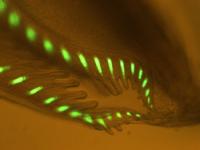
Fluorescence shown along the body structure of amphioxus. Fluorescent proteins found in nature have been employed in a variety of scientific research purposes, from markers for tracing molecules in biomedicine to probes for testing environmental quality. Until now, such proteins have been identified mostly in jellyfish and corals, leading to the belief that the capacity for fluorescence in animals is exclusive to such primitive creatures.

| Biology | October 31, 2007 11:35 PM |
| Full story | 0 Comments | 7738 views |

| Molecular & Cell Biology | October 31, 2007 10:35 PM |
A discovery about the genetics of coat color in dogs could help explain why humans come in different weights and vary in our abilities to cope with stress, a team led by researchers from the Stanford University School of Medicine reports.
| Full story | 0 Comments | 7682 views |

| Biotechnology | October 31, 2007 09:35 PM |
In a feat that seems like something out of a microscopic version of Star Trek, MIT researchers have found a way to use a “tractor beam” of light to pick up, hold, and move around individual cells and other objects on the surface of a microchip.
| Full story | 1 Comment | 6721 views |
| Molecular & Cell Biology | October 31, 2007 08:35 PM |
Interferon, the “superhero” cure for viral infections, may be a strong weapon in the battle against fungal infections in immunocompromised patients, according to an article in the November issue of Microbiology Today.
| Full story | 0 Comments | 7321 views |
| Biology | October 31, 2007 07:35 PM |
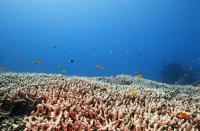
A coral reef and tropical fish off of Ishigaki-jima Island.
The latest development in a major debate over a controversial hypothesis of biodiversity and species abundance is the subject of a paper to be published in the 1 November 2007 issue of the journal Nature. The authors report good agreement between the species richness of two of the world's most vulnerable ecosystems -- tropical forests and coral reefs -- and a simple mathematical model building on the so-called "neutral theory of biodiversity." "We're helping to refine and improve this theory because it might have important implications for the effort to protect terrestrial biodiversity from climate change and urban development," says Jayanth Banavar of the Department of Physics at Penn State, a member of the research team.
| Full story | 0 Comments | 7788 views |

| Health & Medicine | October 31, 2007 06:35 PM |
Duke University Medical Center researchers have used imaging technology to identify a new marker that may help identify those at greatest risk for cognitive decline and the development of Alzheimer's disease.
| Full story | 0 Comments | 6534 views |
| Biology | October 31, 2007 05:35 PM |
Using recently discovered “fossil snapshots” found in rocks more than 500 million years old, three University of Kansas researchers have described the oldest definitive jellyfish ever found.
| Full story | 0 Comments | 8101 views |

| Stem Cell Research | October 31, 2007 04:35 PM |
Heart disease is the leading cause of death in the United States and greatly affects the quality and length of life for individuals with specific forms of muscular dystrophy. Recent discoveries have demonstrated that gene and/or stem cell therapy could help a variety of organs in the body, but until now scientists have been unsure whether the heart could benefit from these treatments. According to a new study, recently published in Circulation Research, a journal of the American Heart Association, University of Missouri-Columbia researchers have demonstrated that a muscular dystrophy patient should be able to maintain a normal lifestyle if only 50 percent of the cells of the heart are healthy.
| Full story | 0 Comments | 7925 views |
| Molecular & Cell Biology | October 31, 2007 03:35 PM |
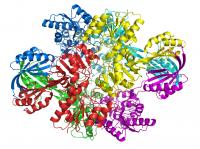
These simplified images from Wayne Anderson's lab show how the polypeptide backbone of a Bacillus anthracis protein folds and curls around itself like a ribbon. It is one of 5,617 proteins in the bacteria that cause anthrax. Credit: Wayne Anderson A scientist slides on a pair of plastic 3-D glasses and an unearthly blue multi-armed creature -- an image right out of a sci-fi horror flick -- seems to leap out of the computer screen into the laboratory.
| Full story | 0 Comments | 6917 views |
| Molecular & Cell Biology | October 31, 2007 01:35 PM |
Researchers at the University of Pittsburgh School of Medicine have identified a new gene responsible for a rare, inherited form of sudden cardiac arrest, known as Brugada syndrome. With the identification of this new gene, the researchers hope this will shed light on the more common forms of sudden death in patients with heart attacks and heart failure, and will help aid in the development of new, effective therapeutic treatments that will prevent all types of fatal arrhythmias.
| Full story | 0 Comments | 7396 views |

- In some genetic cases of microcephaly, stem cells fail to launch
- Yale team discovers how Zika virus causes fetal brain damage
- Scientists uncover the way a common cell enzyme alerts the body to invading bacteria
- Arctic gives clues on worst mass extinction of life
- Calcium channel blockers caught in the act at atomic level
Search Bio News Net
Free Biology Newsletter
- Flexibility That A.C.A. Lent to Work Force Is Threatened by...International Herald Tribune
- Bacteria Behind Legionnaires’ Disease Found at New York Police StationInternational Herald Tribune
- Prescription Price Crisis? 28 Million Americans See Spike in Drug...MSNBC.com: Health
- Seizing on Opioid Crisis, a Drug Maker Lobbies Hard for...International Herald Tribune
- Republicans are taking a big political risk on health careAP Health News
- Why We're So Divided Over Saving WolvesNational Geographic News