

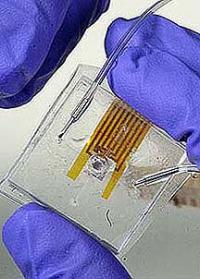
Johns Hopkins researchers have developed this thumb-sized microincubator. A syringe is used to inject living cells and nutrients into the device. Integrating silicon microchip technology with a network of tiny fluid channels, some thinner than a human hair, researchers at The Johns Hopkins University have developed a thumb-size micro-incubator to culture living cells for lab tests.

| Biotechnology | October 3, 2007 11:07 PM |
| Full story | 0 Comments | 6014 views |

| Biology | October 3, 2007 10:07 PM |
A new study in the October issue of Cell Metabolism, a publication of Cell Press, reveals that worms live to an older age when they are unable to process the simple sugar glucose. Glucose is a primary source of energy for the body and can be found in all major dietary carbohydrates as a component of starches and other forms of sugar, including sucrose (table sugar) and lactose.
| Full story | 0 Comments | 7324 views |

| Environment | October 3, 2007 09:07 PM |

CSIRO and the Bureau of Meteorology have produced a report which provides state-by-state climate change projections. The most comprehensive assessment to date of Australia’s climate was jointly released today by the Bureau of Meteorology and CSIRO at GREENHOUSE 2007 in Sydney.
| Full story | 0 Comments | 6489 views |
| Biotechnology | October 3, 2007 08:07 PM |
A plant-like micro-organism mostly found in oceans could make the manufacture of products, from iridescent cosmetics, paints and fabrics to credit card holograms, cheaper and ‘greener’.
| Full story | 0 Comments | 5622 views |

| Microbiology | October 3, 2007 07:07 PM |
New help may be on the way for beleaguered growers of popular cucurbit crops like cucumbers and watermelons. Many varieties of the widely grown bottlegourd (Lagenaria siceraria) appear to have resistance to Zucchini yellow mosaic virus (ZYMV), a scourge of commercial cucurbits that includes pumpkins, squashes and other kinds of melons, including watermelons. ZYMV infects cucurbits throughout North America and in other parts of world, and is a particular concern to U.S. producers of watermelon, a crop valued at $435 million in 2006.
| Full story | 0 Comments | 6670 views |
| Environment | October 3, 2007 06:07 PM |
Swedish researchers have discovered that oseltamivir (Tamiflu); an antiviral drug used to prevent and mitigate influenza infections is not removed or degraded during normal sewage treatment. Consequently, in countries where Tamiflu is used at a high frequency, there is a risk that its concentration in natural waters can reach levels where influenza viruses in nature will develop resistance to it. Widespread resistance of viruses in nature to Tamiflu increases the risk that influenza viruses infecting humans will become resistant to one of the few medicines currently available for treating influenza.
| Full story | 0 Comments | 6914 views |

| Molecular & Cell Biology | October 3, 2007 05:07 PM |
PLoS ONE publishes a study showing that inhalation of carbon dioxide (CO2) triggers emotional distress and a panic response in healthy individuals. The findings of the study posit panic as an inborn survival-oriented response. The results may be relevant for a better understanding and the further prevention of emotional disorders.
| Full story | 0 Comments | 6565 views |
| Environment | October 3, 2007 04:07 PM |
The ozone hole over Antarctica has shrunk 30 percent as compared to last year's record size. According to measurements made by ESA’s Envisat satellite, this year’s ozone loss peaked at 27.7 million tonnes, compared to the 2006 record ozone loss of 40 million tonnes.
| Full story | 0 Comments | 6661 views |
| Biology | October 3, 2007 03:07 PM |
New research shows how the houseplant "mother of thousands" (Kalanchoe diagremontiana) makes the tiny plantlets that drop from the edges of its leaves. Having lost the ability to make viable seeds, the plant has shifted some of the processes that make seeds to the leaves, said Neelima Sinha, professor of plant biology at UC Davis.
| Full story | 1 Comment | 7337 views |

| Health & Medicine | October 3, 2007 02:07 PM |
A test to detect the very early stages of cancer could one day result from new research by Cardiff University scientists.
| Full story | 0 Comments | 6176 views |
| Microbiology | October 3, 2007 12:07 PM |
Johns Hopkins researchers say they have figured out how human and all animal cells tune in to a key signal, one that literally transmits the instructions that shape their final bodies. It turns out the cells assemble their own little radio antenna on their surfaces to help them relay the proper signal to the developmental proteins “listening” on the inside of the cell.
| Full story | 0 Comments | 8574 views |

- In some genetic cases of microcephaly, stem cells fail to launch
- Yale team discovers how Zika virus causes fetal brain damage
- Scientists uncover the way a common cell enzyme alerts the body to invading bacteria
- Arctic gives clues on worst mass extinction of life
- Calcium channel blockers caught in the act at atomic level
Search Bio News Net
Free Biology Newsletter
- Flexibility That A.C.A. Lent to Work Force Is Threatened by...International Herald Tribune
- Bacteria Behind Legionnaires’ Disease Found at New York Police StationInternational Herald Tribune
- Prescription Price Crisis? 28 Million Americans See Spike in Drug...MSNBC.com: Health
- Seizing on Opioid Crisis, a Drug Maker Lobbies Hard for...International Herald Tribune
- Republicans are taking a big political risk on health careAP Health News
- Why We're So Divided Over Saving WolvesNational Geographic News