

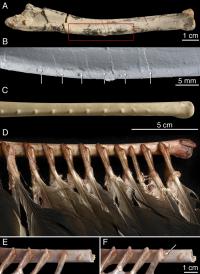
(A) View of right ulna of Velociraptor IGM 100/981.
(B) Detail from cast of red box in (A), with arrows showing six evenly spaced feather quill knobs.
(C) View of right ulna of a turkey vulture (Cathartes).
(D) Same view of Cathartes as in (C) but with soft tissue dissected to reveal placement of the secondary feathers relative to the quill knobs.
(E) Detail of Cathartes, with one quill completely removed to reveal quill knob.
(F) Same view as in (E) but with quill moved to the left to show placement of quill, knob, and follicular ligament. Follicular ligament indicated with arrow. Credit: Mick Ellison A new look at some old bones have shown that velociraptor, the dinosaur made famous in the movie Jurassic Park, had feathers. A paper describing the discovery, made by paleontologists at the American Museum of Natural History and the Field Museum of Natural History, appears in the Sept. 21 issue of the journal Science.

| Biology | September 21, 2007 06:14 PM |
| Full story | 0 Comments | 9071 views |

| Environment | September 21, 2007 04:47 PM |
Drought-stricken regions of the Amazon forest grew particularly vigorously during the 2005 drought, according to new research.
| Full story | 0 Comments | 6572 views |

| Bioinformatics | September 21, 2007 04:47 PM |
A group of computer scientists, mathematicians, and biologists from around the world have developed a computer algorithm that can help trace the genetic ancestry of thousands of individuals in minutes, without any prior knowledge of their background. The team’s findings will be published in the September 2007 edition of the journal PLoS Genetics.
| Full story | 0 Comments | 6531 views |
| Environment | September 21, 2007 12:15 PM |
If you want to catch a trophy northern pike, walleye or brook trout in the northern Canadian wilderness, better plan your trip soon. That’s because according to a report released today by the Wildlife Conservation Society, looming development, including forestry, mining and dam construction, threatens this pristine region of untouched forests, wetlands, lakes and streams. But the authors of the report also say that that there is still time for government officials to enact safeguards ensuring that northern fisheries remain a valuable resource for the future.
| Full story | 0 Comments | 5443 views |

| Microbiology | September 21, 2007 12:14 PM |
An international team of researchers has revealed the genetic secrets of one of the world’s most debilitating human parasites, Brugia malayi (B. malayi), which the World Health Organization estimates has seriously incapacitated and disfigured more than 40 million people around the globe. The study, which appears in the September 21 issue of the journal Science, reveals dozens of potential new targets for drugs or vaccines and should provide new opportunities for understanding, treating and preventing elephantiasis, the disfiguring disease caused by the B. malayi parasite. In addition, understanding how this particular parasite has adapted to humans may help organ transplant researchers, according to the authors.
| Full story | 0 Comments | 5903 views |
| Biology | September 21, 2007 10:14 AM |
Giving Nobel Laureate James Watson his personal genome was just the beginning. In a future that promises similar information to much of the population, ethicists, scientists and physicians are only beginning to understand and consider the possibilities.
| Full story | 0 Comments | 4850 views |

- In some genetic cases of microcephaly, stem cells fail to launch
- Yale team discovers how Zika virus causes fetal brain damage
- Scientists uncover the way a common cell enzyme alerts the body to invading bacteria
- Arctic gives clues on worst mass extinction of life
- Calcium channel blockers caught in the act at atomic level
Search Bio News Net
Free Biology Newsletter
- Flexibility That A.C.A. Lent to Work Force Is Threatened by...International Herald Tribune
- Bacteria Behind Legionnaires’ Disease Found at New York Police StationInternational Herald Tribune
- Prescription Price Crisis? 28 Million Americans See Spike in Drug...MSNBC.com: Health
- Seizing on Opioid Crisis, a Drug Maker Lobbies Hard for...International Herald Tribune
- Republicans are taking a big political risk on health careAP Health News
- Why We're So Divided Over Saving WolvesNational Geographic News