

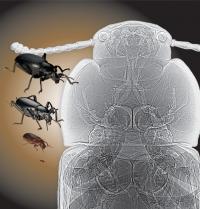
X-ray imaging of beetles helps confirm that tracheal system design may limit size in insects. More of the body is filled with air-filled tracheal tubes in larger species, particularly in the legs, and so much larger species than exist today might not have room for enough tubes. Credit: Argonne National Laboratory Researchers at the U.S. Department of Energy's Argonne National Laboratory have cast new light on why the giant insects that lived millions of years ago disappeared.

| Biology | August 13, 2007 08:46 PM |
| Full story | 0 Comments | 8926 views |

| Biotechnology | August 13, 2007 06:46 PM |
Oregon Health & Science University researchers have figured out how to turn a mouse into a factory for human liver cells that can be used to test how pharmaceuticals are metabolized.
| Full story | 0 Comments | 9150 views |

| Health & Medicine | August 13, 2007 04:46 PM |
Today, researchers report for the first time that genetic variants in mitochondria—energy-producing structures harboring DNA that are inherited only from the mother—are directly linked to metabolic markers for type 2 diabetes. The study, which highlights the role of mitochondrial genome variation in the pathogenesis of common diseases, is published online in Genome Research (www.genome.org).
| Full story | 0 Comments | 6787 views |

| Molecular & Cell Biology | August 13, 2007 02:46 PM |
Researchers at the University of Pennsylvania School of Medicine have found that proteins known to promote cell death are also necessary for the maturation and proliferation of immune cells. Activation of T-cell receptors on the surface of lymphocytes by foreign antigens initiate a calcium-mediated signaling pathway that ends in cell differentiation and growth. The Penn scientists discovered that in the cells that lack the pro-death proteins Bax and Bak, calcium signaling is disrupted and energy production is reduced. Restoration of Bax corrects the signaling problems, increases energy production, and stimulates cell division.
| Full story | 0 Comments | 5625 views |
| Molecular & Cell Biology | August 13, 2007 12:46 PM |
A team of Brooklyn College researchers has shattered a long-held belief that no direct pathway exists between material outside of a cell and the cell nucleus.
| Full story | 0 Comments | 6732 views |
| Health & Medicine | August 13, 2007 10:46 AM |
A previously unknown side effect of an unnamed drug currently on the marketplace could be useful for treating acne, reports Chemistry & Industry, the magazine of the SCI. A UK company is about to start a Phase 1 trial with the drug involving 18 healthy human volunteers and the results are expected to be announced later this year. In an earlier Phase 1 study in nine healthy human volunteers, the treatment was seen to reduce the excretion of sebum by the skin, which is associated with acne development, by up to 70%.
| Full story | 0 Comments | 6648 views |
| Molecular & Cell Biology | August 13, 2007 08:46 AM |
The striking differences between humans and chimps aren’t so much in the genes we have, which are 99 percent the same, but in the way those genes are used, according to new research from a Duke University team.
| Full story | 1 Comment | 5926 views |
| Molecular & Cell Biology | August 13, 2007 06:46 AM |
A new imaging technique developed at MIT has allowed scientists to create the first 3D images of a living cell, using a method similar to the X-ray CT scans doctors use to see inside the body.
| Full story | 1 Comment | 7331 views |

- In some genetic cases of microcephaly, stem cells fail to launch
- Yale team discovers how Zika virus causes fetal brain damage
- Scientists uncover the way a common cell enzyme alerts the body to invading bacteria
- Arctic gives clues on worst mass extinction of life
- Calcium channel blockers caught in the act at atomic level
Search Bio News Net
Free Biology Newsletter
- Flexibility That A.C.A. Lent to Work Force Is Threatened by...International Herald Tribune
- Bacteria Behind Legionnaires’ Disease Found at New York Police StationInternational Herald Tribune
- Prescription Price Crisis? 28 Million Americans See Spike in Drug...MSNBC.com: Health
- Seizing on Opioid Crisis, a Drug Maker Lobbies Hard for...International Herald Tribune
- Republicans are taking a big political risk on health careAP Health News
- Why We're So Divided Over Saving WolvesNational Geographic News