


A £9.2m research centre at the University of Nottingham will break new ground in our understanding of plant growth and could lead to the development of drought-resistant crops for developing countries.

| Environment | June 27, 2007 10:32 PM |
World Wildlife Fund today announced its opposition to a plan by Planktos, Inc. (OTCBB: PLKT) to dump iron dust in the open ocean west of the Galapagos Islands. The experiment seeks to induce phytoplankton blooms in the hopes that the microscopic marine plants will absorb carbon dioxide. The company is speculating on lucrative ways to combat climate change.
| Full story | 0 Comments | 5323 views |

| Molecular & Cell Biology | June 27, 2007 09:32 PM |
Scientists from the National Institute of Arthritis and Musculoskeletal and Skin Diseases (NIAMS), National Cancer Institute (NCI), and Integrative Bioinformatics Inc. have made an important discovery about the role of an enzyme called ataxia telangiectasia mutated protein (ATM) in the body’s ability to repair damaged DNA. NIAMS and NCI are part of the National Institutes of Health (NIH).
| Full story | 0 Comments | 6029 views |

| Microbiology | June 27, 2007 08:32 PM |
CSIRO scientists have played a key role in discovering that bats are the likely host of a new virus that can cause a serious but apparently non-fatal respiratory tract illness in humans.
| Full story | 0 Comments | 6133 views |
| Molecular & Cell Biology | June 27, 2007 02:55 PM |
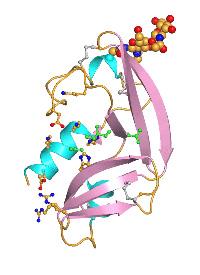
Amphinase molecule A synthetic version of a molecule found in the egg cells of the Northern Leopard frog (Rana pipiens) could provide the world with the first drug treatment for brain tumours.
| Full story | 0 Comments | 6410 views |
| Molecular & Cell Biology | June 27, 2007 12:55 PM |
Investigators from the Institute of Research in Biomedicine (IRB Barcelona) have identified a new signalling mechanism among cells in the fruit fly, Drosophila melanogaster. The researchers found that two independent groups of cells generate the same signal by different pathways and that these cells subsequently act together to send the signal to the target cell. In this manner, the receptor cell receives the signal from two distinct sources. The results of this study appear in today’s advanced electronic issue of the journal, PNAS.
| Full story | 0 Comments | 6387 views |
| Microbiology | June 27, 2007 10:55 AM |
For more than 100 years, scientists have known that humans carry a rich ecosystem within their intestines. An astonishing number and variety of microbes, including as many as 400 species of bacteria, help humans digest food, mitigate disease, regulate fat storage, and even promote the formation of blood vessels. By applying sophisticated genetic analysis to samples of a year’s worth baby poop, Howard Hughes Medical Institute researchers have now developed a detailed picture of how these bacteria come and go in the intestinal tract during a child’s first year of life.
| Full story | 0 Comments | 8543 views |

- In some genetic cases of microcephaly, stem cells fail to launch
- Yale team discovers how Zika virus causes fetal brain damage
- Scientists uncover the way a common cell enzyme alerts the body to invading bacteria
- Arctic gives clues on worst mass extinction of life
- Calcium channel blockers caught in the act at atomic level
Search Bio News Net
Free Biology Newsletter
- Flexibility That A.C.A. Lent to Work Force Is Threatened by...International Herald Tribune
- Bacteria Behind Legionnaires’ Disease Found at New York Police StationInternational Herald Tribune
- Prescription Price Crisis? 28 Million Americans See Spike in Drug...MSNBC.com: Health
- Seizing on Opioid Crisis, a Drug Maker Lobbies Hard for...International Herald Tribune
- Republicans are taking a big political risk on health careAP Health News
- Why We're So Divided Over Saving WolvesNational Geographic News