

WHAT: Adults with obstructive sleep apnea benefit significantly from longer nightly use of continuous positive airway pressure (CPAP), a device to improve breathing during sleep, according to a new study supported by the National Heart, Lung, and Blood Institute (NHLBI) of the National Institutes of Health. This is the first study to identify the nightly duration of CPAP use needed to gain maximum benefit for daytime alertness and functioning.

| Health & Medicine | June 7, 2007 10:56 PM |
Blocking a single protein with an experimental drug prevented and treated both type 2 diabetes and atherosclerosis in laboratory mice that had been fed unhealthy diets and were genetically predisposed to these common killers, according to an article published online at Nature on June 6, 2007. The team was led by senior author Gökhan Hotamisligil, chair of the Department of Genetics and Complex Diseases at the Harvard School of Public Health (HSPH). Lead author was Masato Furuhashi, research fellow in the department.
| Full story | 0 Comments | 5180 views |
| Health & Medicine | June 7, 2007 09:56 PM |
Millions of children with epilepsy in developing countries are being denied an effective drug that costs less than $3 a year, according to an editorial in this week’s BMJ.
| Full story | 0 Comments | 5246 views |
| Health & Medicine | June 7, 2007 06:38 PM |
The goal is to make human eggs, ovarian tissue, blood vessels, even whole organs available when needed.
| Full story | 1 Comment | 4752 views |

| Molecular & Cell Biology | June 7, 2007 04:38 PM |
Cold Spring Harbor, N.Y. – Cold Spring Harbor Laboratory (CSHL) researchers led by Lin He, Xingyue He, and Professor and Howard Hughes Medical Investigator (HHMI) Greg Hannon have identified a family of micro RNAs (miRNAs) that enable a critical tumor suppressor network, called the p53 pathway, to fight cancer growth. “At CSHL, we are moving simultaneously on several fronts to understand the p53 pathway because damage to this pathway is something that almost all cancers have in common,” said CSHL Cancer Center Deputy Director and HHMI Scott Lowe.
| Full story | 0 Comments | 5150 views |

| Biology | June 7, 2007 02:38 PM |
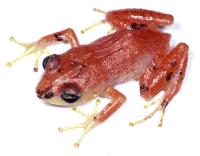
Red frog from mountains of Haiti. Eleutherodactylus audanti, from
Massif de la Selle. Nearly all of the 162 land-breeding frog species on Caribbean islands, including the coqui frogs of Puerto Rico, originated from a single frog species that rafted on a sea voyage from South America about 30-to-50-million years ago, according to DNA-sequence analyses led by a research group at Penn State, which will be published in the 12 June 2007 issue of the Proceedings of the National Academy of Sciences and posted in the journal's online early edition this week. Similarly, the scientists found that the Central American relatives of these Caribbean amphibians also arose from a single species that arrived by raft from South America.
| Full story | 0 Comments | 8584 views |

| Microbiology | June 7, 2007 12:38 PM |
A close cousin of the bacterium that debilitated thousands of World War I soldiers has been isolated at UCSF from a patient who had been on an international vacation. The woman, who has since recovered, suffered from symptoms similar to malaria or typhoid fever, two infections that can occur in returning travelers.
| Full story | 0 Comments | 5752 views |

| Stem Cell Research | June 7, 2007 10:38 AM |
Researchers at the Abramson Family Cancer Research Institute of the University of Pennsylvania have found that deleting a gene important in embryo development leads to premature aging and loss of stem cell reservoirs in adult mice. This gene, ATR, is essential for the body’s response to damaged DNA, and mutations in proteins in the DNA damage response underlie certain types of cancer and other disorders in humans. This work appears in the inaugural issue of Cell Stem Cell.
| Full story | 0 Comments | 7573 views |

- In some genetic cases of microcephaly, stem cells fail to launch
- Yale team discovers how Zika virus causes fetal brain damage
- Scientists uncover the way a common cell enzyme alerts the body to invading bacteria
- Arctic gives clues on worst mass extinction of life
- Calcium channel blockers caught in the act at atomic level
Search Bio News Net
Free Biology Newsletter
- Flexibility That A.C.A. Lent to Work Force Is Threatened by...International Herald Tribune
- Bacteria Behind Legionnaires’ Disease Found at New York Police StationInternational Herald Tribune
- Prescription Price Crisis? 28 Million Americans See Spike in Drug...MSNBC.com: Health
- Seizing on Opioid Crisis, a Drug Maker Lobbies Hard for...International Herald Tribune
- Republicans are taking a big political risk on health careAP Health News
- Why We're So Divided Over Saving WolvesNational Geographic News