

An immune system component that is a primary cause of bone destruction and inflammation in autoimmune diseases such as rheumatoid arthritis actually protects bone in the oral cavity from infectious pathogens that play a major role in periodontal disease in humans, research at the University at Buffalo has shown.

| Health & Medicine | May 8, 2007 09:41 PM |
After screening hundreds of compounds for their effects on fat development, researchers have discovered that an ingredient found in some plants fights diabetes in mice without some of the side effects attributed to other antidiabetes drugs. The chemical they pinpointed, known as harmine, was first isolated more than 150 years ago from plants traditionally included in ritual and medicinal preparations around the world, the team reports in the May issue of the journal Cell Metabolism, published by Cell Press.
| Full story | 0 Comments | 4730 views |

| Microbiology | May 8, 2007 08:41 PM |
People infected with the hepatitis C virus (HCV) are at an increased risk of developing certain lymphomas (cancers of the lymphatic system), according to a study published in the May 8, 2007, issue of the Journal of the American Medical Association. Researchers from the National Cancer Institute (NCI), part of the National Institutes of Health, and Baylor College of Medicine, found that HCV infection increased the risk of developing non-Hodgkin's lymphoma by 20 percent to 30 percent. The risk of developing Waldenström's macroglobulinemia (a rare type of non-Hodgkin's lymphoma) went up by 300 percent and the risk for cryoglobulinemia, a condition marked by abnormal levels of certain antibodies in the blood, was also elevated for those with HCV infections.
| Full story | 0 Comments | 4993 views |

| Biotechnology | May 8, 2007 07:41 PM |
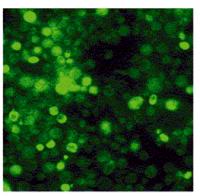
When the biosensor detects DNT, it lights up green. Temple University School of Medicine researchers have developed a new biosensor that sniffs out explosives and could one day be used to detect landmines and deadly agents, such as sarin gas, according to a paper in the June issue of Nature Chemical Biology.
| Full story | 0 Comments | 7383 views |

| Molecular & Cell Biology | May 8, 2007 06:41 PM |
For years, scientists have studied the molecular basis of memory storage, trying to find the molecules that store memory, just as DNA stores genetic memory. In an important study published this week in the Journal of Neuroscience, Brandeis University researchers report for the first time that memory storage can be induced and then biochemically erased in slices of rat hippocampus by manipulating a so-called "memory molecule," a protein kinase known as CaMKII.
| Full story | 0 Comments | 5400 views |
| Molecular & Cell Biology | May 8, 2007 06:03 PM |
The human and chimpanzee genomes vary by just 1.2 percent, yet there is a considerable difference in the mental and linguistic capabilities between the two species. A new study showed that a certain form of neuropsin, a protein that plays a role in learning and memory, is expressed only in the central nervous systems of humans and that it originated less than 5 million years ago. The study, which also demonstrated the molecular mechanism that creates this novel protein, will be published online in Human Mutation, the official journal of the Human Genome Variation Society. The journal is available online via Wiley InterScience at http://www.interscience.wiley.com/journal/humanmutation.
| Full story | 0 Comments | 4670 views |
| Health & Medicine | May 8, 2007 05:03 PM |
The likelihood of developing bipolar disorder depends in part on the combined, small effects of variations in many different genes in the brain, none of which is powerful enough to cause the disease by itself, a new study shows. However, targeting the enzyme produced by one of these genes could lead to development of new, more effective medications. The research was conducted by scientists at the National Institutes of Health's National Institute of Mental Health (NIMH), with others from the Universities of Heidelberg and Bonn and a number of U.S. facilities collaborating in a major project called the NIMH Genetics Initiative.
| Full story | 0 Comments | 4593 views |

| Environment | May 8, 2007 04:03 PM |
Coral disease outbreaks have struck the healthiest sections of Australia's Great Barrier Reef, where for the first time researchers have conclusively linked disease severity and ocean temperature. Close living quarters among coral may make it easy for infection to spread, researchers have found.
| Full story | 0 Comments | 5682 views |

| Biology | May 8, 2007 02:03 PM |
Ever since the relationship between land area and number of species crystallized into a mathematical power function, islands and island archipelagoes have been thought of as biological destinations where species from large continents arrive and, over time, evolve into new species in geographic seclusion.
| Full story | 0 Comments | 6373 views |
| Microbiology | May 8, 2007 12:03 PM |
Respiratory syncytial virus (RSV) infection is a widespread infant illness that has been linked to asthma and can be deadly but may be curable by the development of this new vaccine technology by the Sir Albert Sakzewski Virus Research Centre and The University of Queensland's Faculty of Biological and Chemical Sciences.
| Full story | 0 Comments | 4577 views |

- In some genetic cases of microcephaly, stem cells fail to launch
- Yale team discovers how Zika virus causes fetal brain damage
- Scientists uncover the way a common cell enzyme alerts the body to invading bacteria
- Arctic gives clues on worst mass extinction of life
- Calcium channel blockers caught in the act at atomic level
Search Bio News Net
Free Biology Newsletter
- Flexibility That A.C.A. Lent to Work Force Is Threatened by...International Herald Tribune
- Bacteria Behind Legionnaires’ Disease Found at New York Police StationInternational Herald Tribune
- Prescription Price Crisis? 28 Million Americans See Spike in Drug...MSNBC.com: Health
- Seizing on Opioid Crisis, a Drug Maker Lobbies Hard for...International Herald Tribune
- Republicans are taking a big political risk on health careAP Health News
- Why We're So Divided Over Saving WolvesNational Geographic News