

A new technology developed at the University of Toronto is revealing biochemical processes responsible for diseases such as cystic fibrosis and could one day pave the way for pharmaceutical applications.

| Biology | April 12, 2007 10:43 PM |
In a study that could help reveal how illusions are produced in the brain's visual cortex, researchers at the UCSD School of Medicine have found new evidence of rapid integration of auditory and visual sensations in the brain. Their findings, which provide new insight into neural mechanisms by which visual perception can be altered by concurrent auditory events, will be published online in the April 12 edition of the Journal of Neuroscience.
| Full story | 0 Comments | 7221 views |
| Biology | April 12, 2007 09:43 PM |
The way the liver renews itself may be simpler than what scientists had been assuming. A new study, appearing in the April 13 issue of The Journal of Biological Chemistry, provides new information on the inner workings of cells from regenerating livers that could significantly affect the way physicians make livers regrow in patients with liver diseases such as cirrhosis, hepatitis, or cancer.
| Full story | 0 Comments | 7945 views |

| Molecular & Cell Biology | April 12, 2007 08:43 PM |
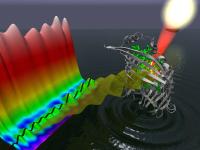
Sunlight absorbed by bacteriochlorophyll (green) within the FMO protein (gray) generates a wavelike motion of excitation energy whose quantum mechanical properties can be mapped through the use of two-dimensional electronic spectroscopy. Credit: Image courtesy of Greg Engel, Lawrence Berkeley National Laboratory, Physical Biosciences Division Through photosynthesis, green plants and cyanobacteria are able to transfer sunlight energy to molecular reaction centers for conversion into chemical energy with nearly 100-percent efficiency. Speed is the key - the transfer of the solar energy takes place almost instantaneously so little energy is wasted as heat. How photosynthesis achieves this near instantaneous energy transfer is a long-standing mystery that may have finally been solved.
| Full story | 0 Comments | 7260 views |

| Microbiology | April 12, 2007 07:43 PM |
The results of a new study suggest that bacteria that cause diseases like bubonic plague and serious gastric illness can turn the genes that make them infectious on or off.
| Full story | 0 Comments | 5348 views |
| Molecular & Cell Biology | April 12, 2007 06:43 PM |
Researchers at the University of Chicago have found an unsuspected link between the immune system and high plasma lipid levels (cholesterol and triglycerides in the blood) in mice. The finding could lead to new ways to reduce the risk of heart disease by lowering elevated lipid levels.
| Full story | 0 Comments | 6437 views |

| Bioinformatics | April 12, 2007 05:43 PM |
An international consortium of researchers has published the genome sequence of the rhesus macaque monkey and aligned it with the chimpanzee and human genomes. Published April 13 in a special section of the journal Science, the analysis reveals that the three primate species share about 93 percent of their DNA, yet have some significant differences among their genes.
| Full story | 0 Comments | 8387 views |
| Biology | April 12, 2007 04:43 PM |
In a venture once thought to lie outside the reach of science, researchers from Harvard Medical School and Beth Israel Deaconess Medical Center have captured and sequenced tiny pieces of collagen protein from a 68 million-year-old Tyrannosaurus rex. The protein fragments—seven in all—appear to most closely match amino acid sequences found in collagen of present day chickens, lending support to a recent and still controversial proposal that birds and dinosaurs are evolutionarily related. The HMS and BIDMC researchers, working with scientists at North Carolina State University, report their findings in the April 13 Science.
| Full story | 0 Comments | 8639 views |

| Environment | April 12, 2007 04:27 PM |
NASA scientists believe they have found a way to predict the color of plants on planets in other solar systems.
| Full story | 0 Comments | 6598 views |
| Molecular & Cell Biology | April 12, 2007 02:27 PM |
Researchers have made a breakthrough by detecting the electrical equivalent of a living cell’s last gasp. The work takes them a step closer to both seeing the ‘heartbeat’ of a living cell and a new way to test drugs.
| Full story | 0 Comments | 4996 views |
| Molecular & Cell Biology | April 12, 2007 12:27 PM |
Up to 15 percent of couples of childbearing age struggle with the heartache of infertility. Now there is the promise of new hope with Cornell researchers' identification of a mutation in a gene that causes male infertility in mice. Because this is the first time that a dominant mutation that leads specifically to infertility in a mammal has been discovered, the researchers say they can now look for similar mutations in the DNA of infertile men.
| Full story | 1 Comment | 6821 views |

| Health & Medicine | April 12, 2007 10:27 AM |
Researchers from Université Laval’s Faculty of Medicine have discovered that a compound commonly used in many antiwrinkle products causes a pathological reaction in skin cells. Guillaume Morissette, Lucie Germain, and François Marceau present their conclusions about the mode of action of this substance—called DMAE—in the latest edition of the British Journal of Dermatology.
| Full story | 0 Comments | 10106 views |

- In some genetic cases of microcephaly, stem cells fail to launch
- Yale team discovers how Zika virus causes fetal brain damage
- Scientists uncover the way a common cell enzyme alerts the body to invading bacteria
- Arctic gives clues on worst mass extinction of life
- Calcium channel blockers caught in the act at atomic level
Search Bio News Net
Free Biology Newsletter
- Flexibility That A.C.A. Lent to Work Force Is Threatened by...International Herald Tribune
- Bacteria Behind Legionnaires’ Disease Found at New York Police StationInternational Herald Tribune
- Prescription Price Crisis? 28 Million Americans See Spike in Drug...MSNBC.com: Health
- Seizing on Opioid Crisis, a Drug Maker Lobbies Hard for...International Herald Tribune
- Republicans are taking a big political risk on health careAP Health News
- Why We're So Divided Over Saving WolvesNational Geographic News