

Maren Roman is taking nanocrystal research to a new level that may lead to a new generation of vaccines and better computer printer ink.

| Biology | March 27, 2007 09:44 PM |

Migratory birds, such as these gulls seen here at a resting staging post, are too readily blamed for the spread of H5N1 without any evidence to support such claims. Credit: Steve Dudley www.toadsnatcher.com A review to be published shortly in the British Ornithologists' Union's journal, Ibis, critically examines the arguments concerning the role of migratory birds in the global dispersal of the highly pathogenic avian influenza virus H5N1. Ecologists of the Station Biologique de la Tour du Valat and of the GEMI-CNRS in the Camargue (France), Michel Gauthier-Clerc, Camille Lebarbenchon and Frédéric Thomas conclude that human commercial activities, particularly those associated with poultry, are the major factors that have determined its global dispersal.
| Full story | 1 Comment | 9495 views |

| Molecular & Cell Biology | March 27, 2007 08:44 PM |
Researchers are searching for new methods and therapies to reduce infarct size and improve blood flow to the heart muscle in patients who experience myocardial infarction (MI), or heart attack.
| Full story | 0 Comments | 19075 views |

| AIDS & HIV | March 27, 2007 07:44 PM |
A Cornell researcher is working to develop a quick, simple and cheap immune-system test for people in the developing world. It could help HIV/AIDS sufferers in the poorest countries get appropriate treatment to extend their lives, possibly by as much as 10 to 15 years.
| Full story | 0 Comments | 6888 views |

| Biotechnology | March 27, 2007 06:44 PM |
To the delight of researchers at Washington University School of Medicine in St. Louis, living cells gobbled up fluorine-laced nanoparticles without needing any coaxing. Then, because of the unusual meal, the cells were easily located with MRI scanning after being injected into mice.
| Full story | 0 Comments | 4979 views |
| Biotechnology | March 27, 2007 05:44 PM |

A.J. Prussin II, a second year student at Virginia Tech who is majoring in biochemistry and biology, with a minor in chemistry, has created an LED system that glows a beautiful shade of blue when special molecules successfully bind to DNA. Credit: David Zigler Biology and chemistry researchers from Virginia Tech are creating molecular complexes to bind to and disrupt the DNA of diseased tissues, such as tumors or viruses. Testing the activity of each of the therapeutic molecule designs has been a time-consuming process. But a student’s invention now provides rapid screening to accelerate discovery of promising new drugs.
| Full story | 0 Comments | 5399 views |
| Molecular & Cell Biology | March 27, 2007 04:44 PM |
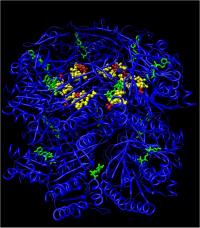
This illustration of KaiC shows the sites where ATP molecules (shown in green) attach and the location of the phosphorylation sites (shown in red). An interdisciplinary team of researchers at Vanderbilt University has analyzed the simplest known biological clock and figured out what makes it tick. The results of their analysis are published in the March 27 issue of the journal Public Library of Science Biology.
| Full story | 0 Comments | 4744 views |
| Molecular & Cell Biology | March 27, 2007 03:44 PM |
The immune system's response against amyloid-beta, the protein that forms plaques in the brains of patients with Alzheimer's disease, appears to protect the brain from damage in early stages of the devastating neurological disorder. A report from Massachusetts General Hospital (MGH) researchers finds that lack of a protein required for recruitment of the brain's primary immune cell led to increased amyloid-beta deposits and earlier death in a mouse model of Alzheimer's disease. The paper will appear in the journal Nature Medicine and has received early online release.
| Full story | 0 Comments | 6680 views |

| Health & Medicine | March 27, 2007 02:44 PM |
The costs due to complications from preterm birth are staggering. In Canada, outlays for specialized care of surviving preterm infants are estimated to be almost $2 billion per year. In a 5-year, randomized, placebo-controlled clinical study, researchers found that giving nitroglycerin to mothers who had entered premature labor led to significant improvement in their baby’s health. The results of the study are reported in the January issue of the American Journal of Obstetrics & Gynecology.
| Full story | 0 Comments | 5938 views |
| Biotechnology | March 27, 2007 01:44 PM |
Large volumes of plastic waste generated aboard military, merchant and cruise ships must be stored onboard, often for prolonged periods, until they make port. In the future, a new type of environmentally friendly plastic that degrades in seawater may make it safe and practical to toss plastic waste overboard, freeing-up valuable storage space, according to scientists at The University of Southern Mississippi (USM).
| Full story | 0 Comments | 6978 views |
| Biotechnology | March 27, 2007 12:43 PM |
Some day, heart attack survivors might have a patch of laboratory-grown muscle placed in their heart, to replace areas that died during their attack. Children born with defective heart valves might get new ones that can grow in place, rather than being replaced every few years. And people with clogged or weak blood vessels might get a new “natural” replacement, instead of a factory-made one.
| Full story | 0 Comments | 5752 views |

- In some genetic cases of microcephaly, stem cells fail to launch
- Yale team discovers how Zika virus causes fetal brain damage
- Scientists uncover the way a common cell enzyme alerts the body to invading bacteria
- Arctic gives clues on worst mass extinction of life
- Calcium channel blockers caught in the act at atomic level
Search Bio News Net
Free Biology Newsletter
- Flexibility That A.C.A. Lent to Work Force Is Threatened by...International Herald Tribune
- Bacteria Behind Legionnaires’ Disease Found at New York Police StationInternational Herald Tribune
- Prescription Price Crisis? 28 Million Americans See Spike in Drug...MSNBC.com: Health
- Seizing on Opioid Crisis, a Drug Maker Lobbies Hard for...International Herald Tribune
- Republicans are taking a big political risk on health careAP Health News
- Why We're So Divided Over Saving WolvesNational Geographic News