

One way to make sense of 165-million-year-old dino tracks may be to hang out with emus, say paleontologists studying thousands of dinosaur footprints at the Red Gulch Dinosaur Tracksite in northern Wyoming. Because they are about the same size, walk on two legs and have similar feet, emus turn out to be the best modern version of the enigmatic reptiles that once trotted along a long-lost coastline in the Middle Jurassic.

| Microbiology | October 25, 2006 10:56 PM |
A benign virus previously used as a marker in tracing human migration may be unreliable, according to researchers at Penn State. Results of this study also suggest that some viruses might be undergoing much higher rates of evolution than previously thought.
| Full story | 0 Comments | 6314 views |

| Biology | October 25, 2006 09:56 PM |
The general disappearance of cougars from a portion of Zion National Park in the past 70 years has allowed deer populations to dramatically increase, leading to severe ecological damage, loss of cottonwood trees, eroding streambanks, and declining biodiversity.
| Full story | 0 Comments | 8712 views |

| Biotechnology | October 25, 2006 08:56 PM |
A new method for targeting malignant brain tumors through inducing the cancerous cells to "commit suicide" has been developed by a team of researchers headed by a Hebrew University of Jerusalem professor of biochemistry.
| Full story | 0 Comments | 9106 views |

| Molecular & Cell Biology | October 25, 2006 07:56 PM |
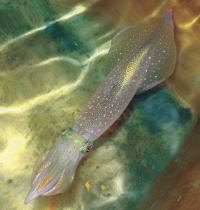
Loligo pealei, the Atlantic squid, has a giant axon that runs the length of its mantle. By injecting designer nanobeads into the giant axon mimicking endogenous cargo, researchers at Brown University and the Marine Biological Laboratory discovered a peptide within amyloid precursor protein that can hitch cargo inside neurons for transport to the synapse. Credit Russell Jacobs and Elaine Bearer/Marine Biological Laboratory. For the first time, researchers have identified a peptide that can spur cargo transport in nerve cells, a discovery that could help scientists better understand nerve cell function and test possible therapies for neurodegenerative diseases.
| Full story | 0 Comments | 7400 views |
| Microbiology | October 25, 2006 06:56 PM |
Investigators at St. Jude Children's Research Hospital have discovered in mouse models how cell walls from certain pneumonia-causing bacteria can cause fatal heart damage; researchers have also shown how antibiotic therapy can contribute to this damage by increasing the number of cell wall pieces shed by dying bacteria. The team also demonstrated in a mouse model how to prevent this from happening.
| Full story | 0 Comments | 7105 views |

| Health & Medicine | October 25, 2006 04:56 PM |
Compared to white patients, black, Asian and Hispanic patients and those who are uninsured are less likely to undergo complex surgery at high-volume hospitals, which have been associated with better outcomes, according to a study in the October 25 issue of JAMA.
| Full story | 0 Comments | 4990 views |
| Biotechnology | October 25, 2006 02:56 PM |
Researchers at the University of Washington (UW) are working on an implantable electronic chip that may help establish new nerve connections in the part of the brain that controls movement. Their most recent study, to be published in the Nov. 2, 2006, edition of Nature, showed such a device can induce brain changes in monkeys lasting more than a week. Strengthening of weak connections through this mechanism may have potential in the rehabilitation of patients with brain injuries, stroke, or paralysis.
| Full story | 0 Comments | 7046 views |
| Molecular & Cell Biology | October 25, 2006 12:12 PM |
Researchers at the University of Georgia, using glow-in-the-dark proteins and microcinematography, have helped unravel the development and function of a complex organelle in the bacterium that causes "walking pneumonia."
| Full story | 0 Comments | 5447 views |
| Molecular & Cell Biology | October 25, 2006 10:12 AM |
The human immune system is a peerless memory bank. Its ability to accurately catalog and recall long past encounters with viruses, bacteria and other pathogens is why we only get the measles or chicken pox once, and is why exposure to deactivated virus particles in vaccines confers protection from disease.
| Full story | 0 Comments | 4717 views |

- In some genetic cases of microcephaly, stem cells fail to launch
- Yale team discovers how Zika virus causes fetal brain damage
- Scientists uncover the way a common cell enzyme alerts the body to invading bacteria
- Arctic gives clues on worst mass extinction of life
- Calcium channel blockers caught in the act at atomic level
Search Bio News Net
Free Biology Newsletter
- Flexibility That A.C.A. Lent to Work Force Is Threatened by...International Herald Tribune
- Bacteria Behind Legionnaires’ Disease Found at New York Police StationInternational Herald Tribune
- Prescription Price Crisis? 28 Million Americans See Spike in Drug...MSNBC.com: Health
- Seizing on Opioid Crisis, a Drug Maker Lobbies Hard for...International Herald Tribune
- Republicans are taking a big political risk on health careAP Health News
- Why We're So Divided Over Saving WolvesNational Geographic News