

Infants whose parents have allergies that produce symptoms like wheezing, asthma, hay fever or hives risk developing allergic sensitization much earlier in life than previously reported, according to a study by Cincinnati researchers.

| Environment | October 12, 2006 10:53 PM |
A first-of-its kind analysis of fifty years of remotely sensed imagery from the 1950s to 2002 shows a dramatic reduction in the size and number of more than 10,000 ponds in Alaska. The analysis, by University of Alaska Fairbanks scientists and published this week in the Journal of Geophysical Research, indicates that these landscape-level changes in arctic ponds are associated with recent climate warming in Alaska and may have profound effects on climate and wildlife.
| Full story | 0 Comments | 5202 views |

| Bioinformatics | October 12, 2006 09:53 PM |
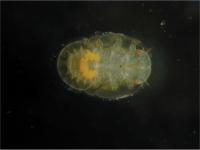
The bright yellow structure inside this newly hatched psyllid insect is the bacteriome, the special structure that houses endosymbiotic bacteria. The smallest collection of genes ever found for a cellular organism comes from tiny symbiotic bacteria that live inside special cells inside a small insect.
| Full story | 0 Comments | 8886 views |

| Molecular & Cell Biology | October 12, 2006 08:53 PM |
Mayo Clinic researchers have found that a protein that initiates a "quality control check" during cell division also directs cell death for those cells damaged during duplication. This knowledge represents a potential "bulls eye" for targeting anti-tumor drugs. The findings appear in the current issue of Science.
| Full story | 0 Comments | 4911 views |

| Biology | October 12, 2006 07:53 PM |
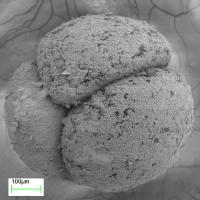
A more-than 551 million year old four-cell embryo magnified using a scanning electronic microscope. The specimen is about 0.65 millimeter in diameter. A group of 15 scientists from five countries has discovered evidence of cell differentiation in fossil embryos that are more than 550 million years old. They also report what appear to be cells about to divide. They used x-ray imaging technologies that produce higher resolutions than hospital-CT scans and digitally extracted cells from the embryos of ancient animals that have been preserved in the Doushantuo Formation, a fossil site in South China.
| Full story | 0 Comments | 10063 views |

| Health & Medicine | October 12, 2006 04:37 PM |
Virginia Commonwealth University researchers have identified a unique mechanism of action of a new drug that shows great promise for the treatment of multiple sclerosis.
| Full story | 0 Comments | 4973 views |

| Biotechnology | October 12, 2006 02:37 PM |
The speed of nanoparticle assembly can be accelerated with the assistance of the molecule that carries life's genetic instructions, DNA, a team of researchers at the U.S. Department of Energy's Brookhaven National Laboratory recently found. Nanoparticles, particles with dimensions on the order of billionths of a meter, could potentially be used for more efficient energy generation and data storage, as well as improved methods for diagnosing and treating disease. Learning how to control and tailor the assembly of these miniscule particles into larger functional systems remains a major challenge for scientists. The Brookhaven results, published online on October 11, 2006, by the Journal of the American Chemical Society, are a step in that direction.
| Full story | 0 Comments | 5491 views |
| Health & Medicine | October 12, 2006 12:37 PM |
University of Queensland telemedicine researchers are using a robot named Eliza to conquer the tyranny of distance and improve delivery of specialist medical care to the bush.
| Full story | 0 Comments | 5067 views |
| Biology | October 12, 2006 10:37 AM |
Researchers have uncovered physiological differences among female Glanville fritillary butterflies that allows some to move away from their birth place and establish new colonies. These venturesome butterflies are stronger fliers and reproduce more quickly compared to their less mobile female relatives.
| Full story | 0 Comments | 6415 views |

- In some genetic cases of microcephaly, stem cells fail to launch
- Yale team discovers how Zika virus causes fetal brain damage
- Scientists uncover the way a common cell enzyme alerts the body to invading bacteria
- Arctic gives clues on worst mass extinction of life
- Calcium channel blockers caught in the act at atomic level
Search Bio News Net
Free Biology Newsletter
- Flexibility That A.C.A. Lent to Work Force Is Threatened by...International Herald Tribune
- Bacteria Behind Legionnaires’ Disease Found at New York Police StationInternational Herald Tribune
- Prescription Price Crisis? 28 Million Americans See Spike in Drug...MSNBC.com: Health
- Seizing on Opioid Crisis, a Drug Maker Lobbies Hard for...International Herald Tribune
- Republicans are taking a big political risk on health careAP Health News
- Why We're So Divided Over Saving WolvesNational Geographic News