


New forms of highly drug-resistant tuberculosis are emerging and action must be taken soon before they become widespread globally, says an editorial in this week's BMJ.

| Biology | September 15, 2006 10:34 PM |
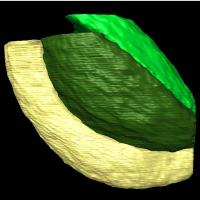
X-ray image of a seed with the seed-coat virtually removed showing the embryonic leaves (green) and stem (beige). Researchers from the CNRS, the University J. Fourier (UJF) of Grenoble and the ESRF have recently visualised a plant seed in 3D using synchrotron light. This new view has revealed that there is a network of voids between the cells which may be used for oxygen storage that is needed for efficient germination. It is the first time that a living organism is studied using the holotomography technique at a third generation synchrotron source. The team behind the discovery publishes its results in PNAS.
| Full story | 0 Comments | 6669 views |

| Health & Medicine | September 15, 2006 09:34 PM |
Easy availability of emergency contraception does not have a notable effect on rates of pregnancy and abortion, according to an editorial in this week's BMJ.
| Full story | 0 Comments | 7141 views |

| Molecular & Cell Biology | September 15, 2006 08:34 PM |
The most aggressively malignant cancer cells have a "toggle switch" that enables them to morph into highly mobile cells that invade other tissues and then nest comfortably in their new surroundings, a new study in rats suggests.
| Full story | 0 Comments | 7359 views |
| Molecular & Cell Biology | September 15, 2006 07:34 PM |
No one has ever seen exactly how water molecules interact with proteins – even though water is the essential element for life . . . that is, not until now.
| Full story | 0 Comments | 5331 views |
| Molecular & Cell Biology | September 15, 2006 06:34 PM |
In higher order animals, genetic information is passed from parents to offspring via sperm or eggs, also known as gametes. In some single-celled organisms, such as yeast, the genes can be passed to the next generation in spores. In both reproductive strategies, major physical changes occur in the genetic material after it has been duplicated and then halved on the way to the production of mature gametes or spores. Near the end of the process, the material – called chromatin, the substructure of chromosomes – becomes dramatically compacted, reduced in volume to as little as five percent of its original volume.
| Full story | 0 Comments | 4793 views |
| Molecular & Cell Biology | September 15, 2006 02:05 PM |
An international team of researchers has shed new light on how tiny molecular motors that transport materials within cells generate the energy that powers their movements.
| Full story | 0 Comments | 5948 views |
| Molecular & Cell Biology | September 15, 2006 12:05 PM |
Like a 1950's Detroit automaker, it appears that nature prefers to build its proteins around a solid, sturdy chassis.
| Full story | 0 Comments | 6448 views |

| Biotechnology | September 15, 2006 10:05 AM |
The worlds of medical and biological research are abuzz with the promises offered by nanoparticles known as semiconductor quantum dots. These Quantum Dots (QDs) have unique optical and electronic properties that make them suitable for breakthrough treatments such as the detection and destruction of cancer cells.
| Full story | 0 Comments | 7923 views |

- In some genetic cases of microcephaly, stem cells fail to launch
- Yale team discovers how Zika virus causes fetal brain damage
- Scientists uncover the way a common cell enzyme alerts the body to invading bacteria
- Arctic gives clues on worst mass extinction of life
- Calcium channel blockers caught in the act at atomic level
Search Bio News Net
Free Biology Newsletter
- Flexibility That A.C.A. Lent to Work Force Is Threatened by...International Herald Tribune
- Bacteria Behind Legionnaires’ Disease Found at New York Police StationInternational Herald Tribune
- Prescription Price Crisis? 28 Million Americans See Spike in Drug...MSNBC.com: Health
- Seizing on Opioid Crisis, a Drug Maker Lobbies Hard for...International Herald Tribune
- Republicans are taking a big political risk on health careAP Health News
- Why We're So Divided Over Saving WolvesNational Geographic News