


Even in the dark, snakes on a plane (at least those of the pit viper and boa varieties) could keep a close watch on terrorized passengers and crew thanks to small cavities near their snouts known as pit organs. The organs are sensitive to the infrared radiation emitted by warm prey such as rats, rabbits, and Samuel L. Jackson. An optical analysis of pit organs suggests that snakes shouldn't be able to use the organ to track prey very well because the pit aperture is large and the organ is not very deep. However, studies have shown that snakes can localize heat sources to a surprisingly accurate resolution of five degrees (roughly the angular width of "Snakes on a Plane" costar Rachel Blanchard at three meters).

| Molecular & Cell Biology | August 7, 2006 10:50 PM |
Organisms, including humans, all inherit DNA from generation to generation, what biologists call hard inheritance because the nucleotide sequence of DNA is constant and only changes by rare random mutation as it is passed down the generations.
| Full story | 1 Comment | 9644 views |

| Microbiology | August 7, 2006 06:43 PM |
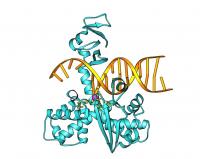
Three-dimensional rotation view of the smallpox virus topoisomerase enzyme-DNA complex (DNA, yellow; topoisomerase, blue; covalent bond between the topoisomerase and the DNA, pink sphere)Researchers at the University of Pennsylvania School of Medicine have determined the structure of an important smallpox virus enzyme and how it binds to DNA. The enzyme, called a topoisomerase, is an important drug target for coming up with new ways to fight smallpox. The researchers present their findings in the August 4 issue of Molecular Cell.
| Full story | 0 Comments | 7898 views |

| AIDS & HIV | August 7, 2006 04:43 PM |
Researchers at the University at Buffalo have presented the first evidence that the addictive drug methamphetamine, or meth, also commonly known as "speed" or "crystal," increases production of a docking protein that promotes the spread of the HIV-1 virus in infected users.
| Full story | 0 Comments | 9426 views |
| Microbiology | August 7, 2006 02:43 PM |
Malaria has been outsmarting the human immune system for centuries. Now, using real-time imaging to track malaria infections in live mice, researchers have discovered one of the parasite's sneakiest tricks--using dead liver cells to cloak and transport itself back into the bloodstream after leaving the liver.
| Full story | 0 Comments | 7202 views |

| Health & Medicine | August 7, 2006 12:43 PM |
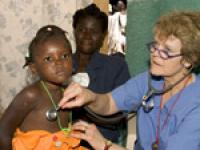
Patricia Wolff, M.D., examines a young patient in her pediatric clinic in Cap Haitien, Haiti, while the girl's mother looks on. Wolff's clinic is often the only medical care available.Swollen bellies, orange hair, listlessness and dull eyes -- these are the traits of child malnutrition in Haiti, the poorest country in the Western Hemisphere and where roughly one of every three children is chronically malnourished.
| Full story | 0 Comments | 5905 views |

| Biotechnology | August 7, 2006 10:43 AM |
It's hard to improve on milk, but animal scientists at the University of California, Davis, have found that milk produced by transgenic goats, which carry the gene for an antibacterial enzyme found in human breast milk, altered the intestinal bacteria in young goats and pigs that were fed the milk.
| Full story | 0 Comments | 7439 views |

- In some genetic cases of microcephaly, stem cells fail to launch
- Yale team discovers how Zika virus causes fetal brain damage
- Scientists uncover the way a common cell enzyme alerts the body to invading bacteria
- Arctic gives clues on worst mass extinction of life
- Calcium channel blockers caught in the act at atomic level
Search Bio News Net
Free Biology Newsletter
- Flexibility That A.C.A. Lent to Work Force Is Threatened by...International Herald Tribune
- Bacteria Behind Legionnaires’ Disease Found at New York Police StationInternational Herald Tribune
- Prescription Price Crisis? 28 Million Americans See Spike in Drug...MSNBC.com: Health
- Seizing on Opioid Crisis, a Drug Maker Lobbies Hard for...International Herald Tribune
- Republicans are taking a big political risk on health careAP Health News
- Why We're So Divided Over Saving WolvesNational Geographic News