


Fatty acids commonly found in dairy products have successfully treated diabetes in mice, according to a researcher at Penn State. The compounds, known as conjugated linoleic acids (CLA), have also shown promising results in human trials, signaling a new way of potentially treating the disease without synthetic drugs.

| Biotechnology | August 4, 2006 06:37 PM |
The words are becoming familiar, even if the products aren't: biofuel, biobased, biodiesel, bioethanol.
| Full story | 0 Comments | 7722 views |

| Bioinformatics | August 4, 2006 04:37 PM |
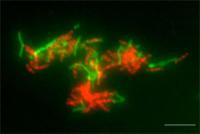
A mixed culture, used to sequence the complete genome of a methane producer, RC-I archaeon. Hybridization, with specific probes for RC-I Archaea (red fluorescent cells) and bacteria (green fluorescent cells)About 10 to 25 percent of the world's methane emissions come from flooded rice paddies. Methane is a greenhouse gas produced by various groups of microorganisms (methanogenic Archaea). Oxygen is usually highly toxic for these microorganisms. The major producer of methane in the roots of rice plants is what is known as 'Rice Cluster I' (RC-I) Archaea. The mechanisms that give these Archaea a competitive advantage remained unexplained, because it was impossible to get a pure culture of them.
| Full story | 0 Comments | 6091 views |

| Molecular & Cell Biology | August 4, 2006 02:37 PM |
For years, researchers have struggled to understand how IVIG worked. It's ability to treat autoimmune diseases seemed to bean apparent contradiction.
| Full story | 0 Comments | 6530 views |
| Molecular & Cell Biology | August 4, 2006 12:37 PM |
Researchers from the Pacific Northwest Research Institute (PNRI) and the National Institute of Standards and Technology (NIST) have uncovered a pattern of DNA damage in connective tissues in the human breast that could shed light on the early stages of breast cancer and possibly serve as an early warning of a heightened risk of cancer.
| Full story | 0 Comments | 5492 views |
| Molecular & Cell Biology | August 4, 2006 10:37 AM |
A team of scientists headed by Dr. Sara Melville at the University of Cambridge has shown that the parasite known to cause African sleeping sickness has evolved an unusual chromosomal structure as a result of environmental adaptation. In this parasite, the chromosomes are highly enriched in subtelomeric sequences – dynamic and variable regions that connect the chromosome ends to the gene-rich cores. These subtelomeres, in some cases comprising 75% of the total chromosome length, contain a large repertoire of genes involved in circumventing the human immune response. This finding challenges scientists' general view of how a chromosome is functionally organized. An article describing the research will appear online this week in the journal Genome Research.
| Full story | 0 Comments | 6580 views |

- In some genetic cases of microcephaly, stem cells fail to launch
- Yale team discovers how Zika virus causes fetal brain damage
- Scientists uncover the way a common cell enzyme alerts the body to invading bacteria
- Arctic gives clues on worst mass extinction of life
- Calcium channel blockers caught in the act at atomic level
Search Bio News Net
Free Biology Newsletter
- Flexibility That A.C.A. Lent to Work Force Is Threatened by...International Herald Tribune
- Bacteria Behind Legionnaires’ Disease Found at New York Police StationInternational Herald Tribune
- Prescription Price Crisis? 28 Million Americans See Spike in Drug...MSNBC.com: Health
- Seizing on Opioid Crisis, a Drug Maker Lobbies Hard for...International Herald Tribune
- Republicans are taking a big political risk on health careAP Health News
- Why We're So Divided Over Saving WolvesNational Geographic News