

The National Human Genome Research Institute (NHGRI), one of the National Institutes of Health (NIH), today announced several new sequencing targets including the Northern white-cheeked gibbon (Nomascus leucogenys), setting the stage for completing a quest to sequence the genome of at least one non-human primate genome from each of the major positions along the evolutionary primate tree and making available an essential resource for researchers unraveling the genetic factors involved in human health and disease. Comparing the genomes of other species to humans is an exceptionally powerful tool to help researchers understand the working parts of the human genome in both health and illness.

| Bioinformatics | July 19, 2006 10:15 PM |
DNA – the long, thin molecule that carries our hereditary material – is compressed around protein scaffolding in the cell nucleus into tiny spheres called nucleosomes. The bead-like nucleosomes are strung along the entire chromosome, which is itself folded and packaged to fit into the nucleus. What determines how, when and where a nucleosome will be positioned along the DNA sequence? Dr. Eran Segal and research student Yair Field of the Computer Science and Applied Mathematics Department at the Weizmann Institute of Science have succeeded, together with colleagues from Northwestern University in Chicago, in cracking the genetic code that sets the rules for where on the DNA strand the nucleosomes will be situated. Their findings appeared today in Nature.
| Full story | 0 Comments | 8550 views |

| Biotechnology | July 19, 2006 09:15 PM |
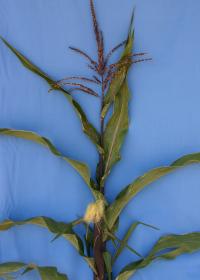
Corn showing the purple coloration from active B-Intense genes.A newly cloned gene in corn will help explain how unusual interactions between a parent's genes can have lasting effects in future generations. The finding has implications for breeding better crop plants and unraveling complex genetic diseases.
| Full story | 0 Comments | 8428 views |
| Biotechnology | July 19, 2006 08:15 PM |
After the corn harvest, whether for cattle feed or corn on the cob, farmers usually leave the stalks and stems in the field, but now, a team of Penn State researchers think corn stover can be used not only to manufacture ethanol, but to generate electricity directly.
| Full story | 0 Comments | 8613 views |

| Health & Medicine | July 19, 2006 06:14 PM |
Researchers from Norway may have ruled out insufficient oxygen supply to the heart as the critical variable in whether a mammal's heart survives while in a hypothermic state.
| Full story | 0 Comments | 7749 views |
| Biotechnology | July 19, 2006 04:14 PM |
A new study, published today in the current issue of the Proceedings of the National Academy of Sciences has significant implications for the design of disease markers and the development of chemoreceptors used in human biomedical research. The groundbreaking study, entitled, "A Mechanism to Signal Receptor-Substrate Interactions with Luminescent Quantum Dots", demonstrates that quantum dots can one day replace conventional organic dyes in biomedical applications.
| Full story | 0 Comments | 8336 views |

| Environment | July 19, 2006 02:14 PM |
A scientist at the Weizmann Institute of Science and his colleagues caused a storm in the atmospheric community when they suggested a few years back that tiny airborne particles, known as aerosols, may be one of the main culprits causing climate change – having, on a local scale, an even greater impact than the greenhouse gases effect. Attempts to understand how these particles influence clouds have generated many uncertainties. A new paper by Dr. Ilan Koren of the Weizmann Institute Environmental Studies and Energy Research Department and Dr. Yoram Kauffman of the NASA/Goddard Space Flight Center, USA,* published in Science Express online, weaves together two opposing effects of atmospheric aerosols to provide a comprehensive picture of how they may be affecting our climate.
| Full story | 0 Comments | 8224 views |
| Health & Medicine | July 19, 2006 12:14 PM |
Scientists know that children of women who smoke during pregnancy can develop hearing-related cognitive deficits. For the first time, researchers believe they have evidence that not only implicates nicotine as the culprit, but also shows what the substance does to the brain to cause these deficits.
| Full story | 0 Comments | 7143 views |

| Molecular & Cell Biology | July 19, 2006 10:14 AM |
Neuroscientists at the Case Western Reserve University School of Medicine have found evidence of which protein in the brain's immune cells triggers a cascade of reactions that produces unregulated free radical production that eventually leads to the neural cell death found in Alzheimer's disease.
| Full story | 0 Comments | 3931 views |

- In some genetic cases of microcephaly, stem cells fail to launch
- Yale team discovers how Zika virus causes fetal brain damage
- Scientists uncover the way a common cell enzyme alerts the body to invading bacteria
- Arctic gives clues on worst mass extinction of life
- Calcium channel blockers caught in the act at atomic level
Search Bio News Net
Free Biology Newsletter
- Flexibility That A.C.A. Lent to Work Force Is Threatened by...International Herald Tribune
- Bacteria Behind Legionnaires’ Disease Found at New York Police StationInternational Herald Tribune
- Prescription Price Crisis? 28 Million Americans See Spike in Drug...MSNBC.com: Health
- Seizing on Opioid Crisis, a Drug Maker Lobbies Hard for...International Herald Tribune
- Republicans are taking a big political risk on health careAP Health News
- Why We're So Divided Over Saving WolvesNational Geographic News