

Faces tell the stories in UC Riverside Professor Larry Rosenblum's ecological listening lab, as volunteer test subjects show that they can "read" unheard speech -- not just from lips, but from the simple movements of dots placed on lips, teeth and tongue.

| Molecular & Cell Biology | April 13, 2006 10:42 PM |
Researchers from the Max Planck Institite for Biophysical Chemistry and other German and French colleagues have combined magnetic resonance spectroscopy (solid-state NMR) with special protein synthesis procedures to uncover how potassium channels and toxins combine and change in structure. This work could make it possible to develop medications for high blood pressure and many other diseases connected to potassium channel failure (Nature, April 13, 2006).
| Full story | 0 Comments | 6225 views |

| Health & Medicine | April 13, 2006 09:42 PM |
Researchers at the University of Pennsylvania School of Medicine have clarified the mechanism by which drugs like Celebrex and Vioxx cause heart problems, in multiple animal models. The findings offer the prospect of a new generation of anti-inflammatory drugs that bypass this issue, as reported in the April 13 advanced online edition and May print issue of The Journal of Clinical Investigation.
| Full story | 0 Comments | 4044 views |

| Biotechnology | April 13, 2006 08:42 PM |
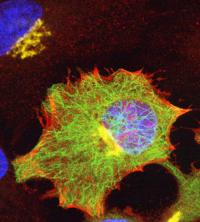
Parallel application of new (genetic tagging) and old targeting methods and fluorophores.An interdisciplinary team of biological imaging experts from the University of California, San Diego has published a review of fluorescent imaging technologies and underscored the importance of those technologies to major advances in the life sciences.
| Full story | 0 Comments | 4600 views |

| Biology | April 13, 2006 07:42 PM |
Scientists have found that worms dwelling at deep-sea hydrothermal vents opt for temperatures of 45-55 degrees Celsius (113-131 degrees Fahrenheit) when given a choice of conditions, giving them the highest thermal preference of any animal studied to date. This unique preference for extreme temperatures may be the undersea worms' meal ticket, since they are apparently the only animals able to access -- and feast on -- lush mats of bacteria that thrive around deep-sea vents.
| Full story | 0 Comments | 4563 views |
| Biotechnology | April 13, 2006 04:32 PM |
University Georgia researchers have developed an anti-microbial treatment that adheres to the skin without being toxic.
| Full story | 0 Comments | 4679 views |
| Biology | April 13, 2006 12:32 PM |
People usually think of the skull as packaging for the brain and researchers usually investigate them separately, but a team of researchers now thinks that developmentally and evolutionarily that the two are incontrovertibly linked.
| Full story | 0 Comments | 4100 views |

- In some genetic cases of microcephaly, stem cells fail to launch
- Yale team discovers how Zika virus causes fetal brain damage
- Scientists uncover the way a common cell enzyme alerts the body to invading bacteria
- Arctic gives clues on worst mass extinction of life
- Calcium channel blockers caught in the act at atomic level
Search Bio News Net
Free Biology Newsletter
- Flexibility That A.C.A. Lent to Work Force Is Threatened by...International Herald Tribune
- Bacteria Behind Legionnaires’ Disease Found at New York Police StationInternational Herald Tribune
- Prescription Price Crisis? 28 Million Americans See Spike in Drug...MSNBC.com: Health
- Seizing on Opioid Crisis, a Drug Maker Lobbies Hard for...International Herald Tribune
- Republicans are taking a big political risk on health careAP Health News
- Why We're So Divided Over Saving WolvesNational Geographic News