

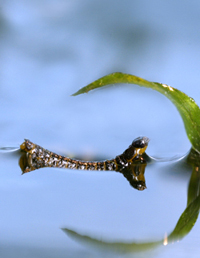
The larva of a waterlily leaf beetle gets ready to propel itself up onto a leaf using a technique recently discovered by MIT researchers. Photo courtesy Hu and Bush, 2005MIT mathematicians have discovered how certain insects can climb what to them are steep, slippery slopes in the water's surface without moving their limbs -- and do it at high speed.

| Biology | September 28, 2005 11:53 PM |
| Full story | 0 Comments | 5863 views |

| Stem Cell Research | September 28, 2005 11:44 PM |
UK scientists are working on new methods to regenerate cartilage and bone by delivering genes to stem cells within the body to instruct them to turn into bone cells. The research, funded by the Biotechnology and Biological Sciences Research Council (BBSRC), could lead to a new approach to tissue engineering. With the ageing populations of Western countries it holds the potential of significant benefits for patients needing joint replacement or similar treatments.
| Full story | 0 Comments | 6741 views |

| Microbiology | September 28, 2005 11:44 PM |
Researchers from the National Institute of Allergy and Infectious Diseases (NIAID), part of the National Institutes of Health, have made the surprising discovery that flaviviruses, which cause such serious diseases as West Nile fever, yellow fever and forms of encephalitis, evade immune system defenses in different ways depending on whether they are transmitted by mosquitoes or ticks. This finding could lead to new approaches to developing vaccines and treatments against these illnesses.
| Full story | 0 Comments | 5545 views |
| Microbiology | September 28, 2005 11:44 PM |
Iron key to nitric oxide reductionResearchers at the Georgia Institute of Technology and the John Innes Centre in the United Kingdom have uncovered a mechanism with which disease-causing bacteria may thwart the body's natural defense responses. The findings, which could ultimately lead to the development of more effective antibiotics, appear in the September 29, 2005 issue of the journal Nature.
| Full story | 0 Comments | 8177 views |

| Molecular & Cell Biology | September 28, 2005 11:44 PM |
By altering a molecule called Stat1, which is involved in cellular immune signaling, scientists have succeeded in making the molecule more responsive and thus more efficient. This old protein with a new twist may eventually be used to improve the body's defense against infection.
| Full story | 0 Comments | 6514 views |
| Microbiology | September 28, 2005 11:44 PM |
Insights may advance vaccines for related viruses including dengue fever. A monoclonal antibody that can effectively treat mice infected with West Nile virus has an intriguing secret: Contrary to scientists' expectations, it does not block the virus's ability to attach to host cells. Instead, the antibody somehow stops the infectious process at a later point.
| Full story | 0 Comments | 6547 views |

| Environment | September 28, 2005 11:43 PM |
In the immediate wake of Hurricane Katrina, scientists and research centers from across the country came together to generate information on the contaminated floodwaters and offer it to hazardous materials experts and public health officials.
| Full story | 0 Comments | 4939 views |

- In some genetic cases of microcephaly, stem cells fail to launch
- Yale team discovers how Zika virus causes fetal brain damage
- Scientists uncover the way a common cell enzyme alerts the body to invading bacteria
- Arctic gives clues on worst mass extinction of life
- Calcium channel blockers caught in the act at atomic level
Search Bio News Net
Free Biology Newsletter
- Flexibility That A.C.A. Lent to Work Force Is Threatened by...International Herald Tribune
- Bacteria Behind Legionnaires’ Disease Found at New York Police StationInternational Herald Tribune
- Prescription Price Crisis? 28 Million Americans See Spike in Drug...MSNBC.com: Health
- Seizing on Opioid Crisis, a Drug Maker Lobbies Hard for...International Herald Tribune
- Republicans are taking a big political risk on health careAP Health News
- Why We're So Divided Over Saving WolvesNational Geographic News