


You should definitively check out the last news item about gene therapy and parkinson; it's really encouraging for further applications of the technology, and not only for Parkinson. After the fiasco some years ago (where a patient died after gene therapy), gene therapy needs every good news it can get.

| Gene Therapy | September 25, 2005 08:04 PM |
Investigators report safety findings and statistically significant improvements in clinical measures of movement, PET Scans at 19th Annual Symposia on the Etiology, Pathogenesis and Treatment of Parkinson's Disease and Other Movement DisordersNeurologix's Phase I trial showed positive interim results in patients with Parkinson's disease. One year following treatment, patients exhibited a statistically significant improvement in motor function on the side of their body correlating to the treated part of the brain. Further, PET scans at one year revealed that the treated side of the brain exhibited a statistically significant decrease in abnormal metabolism, results considered similar to those achieved with STN Deep Brain Stimulation.
| Full story | 0 Comments | 7954 views |

| Microbiology | September 25, 2005 08:04 PM |
The US military wants to buy large quantities of anthrax, in a controversial move that is likely to raise questions over its commitment to treaties designed to limit the spread of biological weapons.
| Full story | 0 Comments | 4952 views |

| Biotechnology | September 25, 2005 08:04 PM |
Use of minuscule devices to spot cancer markers could lead to ultra-powerful new diagnostics
Harvard University researchers have found that molecular markers indicating the presence of cancer in the body are readily detected in blood scanned by special arrays of silicon nanowires -- even when these cancer markers constitute only one hundred-billionth of the protein present in a drop of blood. In addition to this exceptional accuracy and sensitivity, the minuscule devices also promise to pinpoint the exact type of cancer present with a speed not currently available to clinicians.
| Full story | 0 Comments | 5294 views |

| Biology | September 25, 2005 08:04 PM |
One of the remaining challenges for evolutionary developmental studies of mammals, whose evolution is best known from their teeth, is how their tooth shape is altered during development. Researchers of the University of Helsinki together with their Japanese colleagues from the University of Kioto now propose a 'balance of induction' mechanism directing the placement of tooth shape features called cusps. Position and shape of cusps determine whether a tooth shape belongs to human or mouse, for example. Whereas developmental initiation of cusp formation is known to involve several developmental genes at the places of future cusps, it has remained unknown how cusps form at the right places.
| Full story | 0 Comments | 6268 views |

| Molecular & Cell Biology | September 25, 2005 08:04 PM |
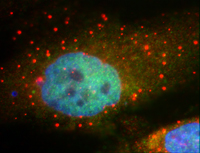
This image shows P-bodies, in red, surrounding the nucleus of a human tumor cell. The red color indicates that the P-bodies contain the protein RCK. Photo credit: John Bloom.Cells can reuse the chemical messengers that carry genetic information to the machinery that makes proteins. Sometimes cells shuttle the messengers to storage and later reactivate them to make proteins, according to new research.
| Full story | 0 Comments | 4692 views |
| Molecular & Cell Biology | September 25, 2005 08:04 PM |
Neuralgic Amyotrophy is a painful disorder of the peripheral nervous system. This heritable disease causes prolonged acute attacks of pain in the shoulder or arm, followed by temporary paralysis. Researchers from the Flanders Interuniversity Institute for Biotechnology (VIB) connected to the University of Antwerp, have uncovered a small piece of the molecular puzzle of this disease by identifying the defects in the gene responsible for this disorder.
| Full story | 0 Comments | 6489 views |

| Environment | September 25, 2005 08:04 PM |
As Hurricane Rita entered the Gulf of Mexico, ESA's Envisat satellite's radar was able to pierce through swirling clouds to directly show how the storm churns the sea surface. This image has then been used to derive Rita's wind field speeds.
| Full story | 0 Comments | 4280 views |
| Environment | September 25, 2005 08:04 PM |
Daily multispectral observations from Envisat's MERIS sensor are being combined with a sophisticated processing algorithm and powerful Grid computing to reveal global photosynthesis activity on land. This permits researchers to trace the state of health of terrestrial plant cover, identifying areas under stress and assessing damage from drought or fires.
| Full story | 0 Comments | 4930 views |

- In some genetic cases of microcephaly, stem cells fail to launch
- Yale team discovers how Zika virus causes fetal brain damage
- Scientists uncover the way a common cell enzyme alerts the body to invading bacteria
- Arctic gives clues on worst mass extinction of life
- Calcium channel blockers caught in the act at atomic level
Search Bio News Net
Free Biology Newsletter
- Flexibility That A.C.A. Lent to Work Force Is Threatened by...International Herald Tribune
- Bacteria Behind Legionnaires’ Disease Found at New York Police StationInternational Herald Tribune
- Prescription Price Crisis? 28 Million Americans See Spike in Drug...MSNBC.com: Health
- Seizing on Opioid Crisis, a Drug Maker Lobbies Hard for...International Herald Tribune
- Republicans are taking a big political risk on health careAP Health News
- Why We're So Divided Over Saving WolvesNational Geographic News