

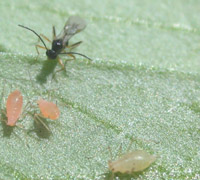
A parasitoid wasp stalks pea aphids so she can lay eggs in them. The wasp is a tad bigger than 0.01 inches long. Photo credit: (c) 2005 Kerry M. Oliver. Carrying the right bacterial hitchhiker can make the difference between life and death for an aphid. Pea aphids are often under attack by wasps seeking to lay their eggs inside aphids, turning them into an all-you-can-eat buffet for the larval wasps.

| Biology | August 25, 2005 11:27 PM |
| Full story | 0 Comments | 6632 views |

| Biotechnology | August 25, 2005 10:27 PM |
New portable device captures pictures beneath the living brain's surfaceResearchers at Stanford University have demonstrated a promising, minimally invasive optical technique that can capture micron-scale images from deep in the brains of live subjects. The method, called two-photon microendoscopy, combines a pair of powerful optical and mechanical techniques into one device that fits in the palm of the hand. The results appear in the September 1, 2005 issue of Optics Letters, a journal published by the Optical Society of America.
| Full story | 0 Comments | 5384 views |

| Molecular & Cell Biology | August 25, 2005 01:27 AM |
Virginia Commonwealth University immunologists studying mast cells, known to play a central role in asthma and allergic disease, have identified a hormone-like molecule that can kill these cells by programming them to die in studies with mice.
| Full story | 0 Comments | 5080 views |

| Environment | August 25, 2005 01:27 AM |
Scientists at the National Center for Atmospheric Research (NCAR) have created a computer simulation showing Earth's climate in unprecedented detail at the time of the greatest mass extinction in the planet's history. The work gives support to a theory that an abrupt and dramatic rise in atmospheric levels of carbon dioxide triggered the massive die-off 251 million years ago. The research appears in the September issue of Geology.
| Full story | 0 Comments | 4437 views |
| Biology | August 25, 2005 01:27 AM |
Killer whales and chimpanzees both pass on "traditions" to other members of their group, according to two separate studies of feeding behaviour. The findings add to evidence that cultural learning is widespread among animals.
| Full story | 0 Comments | 4810 views |

| Health & Medicine | August 25, 2005 01:27 AM |
In an international clinical trial, a new drug that selectively blocks immune responses has proved as effective in preventing acute kidney transplant rejection as cyclosporine, the standard anti-rejection treatment.
| Full story | 0 Comments | 4927 views |
| Molecular & Cell Biology | August 25, 2005 01:27 AM |
Rutgers' Bonnie Firestein likens nerve cells to trees -- some are short and bushy with many branches while others are tall with a few branches coming out of one or two main trunks. Different branching patterns correlate with specific disorders and Firestein's quest is to discover how these dissimilar patterns come about and why.
| Full story | 0 Comments | 4164 views |
| Biology | August 25, 2005 01:24 AM |
Discovery has implications for control of mosquitoes, malaria and West Nile Virus
Prior to coming to Nevada 16 years ago, David Schooley was a key figure at a small company in Palo Alto, Calif. that developed methoprene, an insecticide that halts the maturation of insect larvae to adults.
| Full story | 0 Comments | 6992 views |

- In some genetic cases of microcephaly, stem cells fail to launch
- Yale team discovers how Zika virus causes fetal brain damage
- Scientists uncover the way a common cell enzyme alerts the body to invading bacteria
- Arctic gives clues on worst mass extinction of life
- Calcium channel blockers caught in the act at atomic level
Search Bio News Net
Free Biology Newsletter
- Flexibility That A.C.A. Lent to Work Force Is Threatened by...International Herald Tribune
- Bacteria Behind Legionnaires’ Disease Found at New York Police StationInternational Herald Tribune
- Prescription Price Crisis? 28 Million Americans See Spike in Drug...MSNBC.com: Health
- Seizing on Opioid Crisis, a Drug Maker Lobbies Hard for...International Herald Tribune
- Republicans are taking a big political risk on health careAP Health News
- Why We're So Divided Over Saving WolvesNational Geographic News