

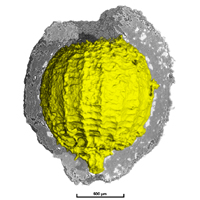
Image of a sycidium gyrogonite surrounded by its utricule.Researchers from the Université de Montpellier II (France), the Institute of Geology of China, and the ESRF have been able to identify enigmatic fossils from Devonian (about 400 million years) as fructification of charophyte algae. Charophytes are land plants living in fresh water that still exist nowadays. This breakthrough allows researchers to better understand the evolution of these very old plants of the Paleozoic era and to have an improved overview of the climate at this period. The use of powerful X-rays beams to perform high resolution microtomography at the ESRF was one of the major keys in helping to understand the internal structure of these fossils. The results of this research are published in the latest issue of the American Journal of Botany with the title "New insights into Paleozoic charophyte morphology and phylogeny".

| Biology | July 23, 2005 06:07 PM |
| Full story | 1 Comment | 4392 views |

| Biotechnology | July 23, 2005 05:06 PM |
Research into the evolution of protein design by a University of Houston professor will be featured among nearly 20 presentations at the 2005 Nano Summit Research Conference July 28.
| Full story | 0 Comments | 4031 views |

| Molecular & Cell Biology | July 23, 2005 04:06 PM |
A team of scientists has discovered three molecules –– from a search of 58,000 compounds –– that appear to inhibit a key perpetrator of Alzheimer's disease.
| Full story | 0 Comments | 3778 views |

| Health & Medicine | July 23, 2005 03:05 PM |
Scientists at Galileo Pharmaceuticals, Inc. have demonstrated a direct relationship between inflammation and glucose levels. Through its recently established metabolic disease program, Galileo confirmed in preclinical models that inhibiting lipoxygenases, known mediators of inflammatory response, significantly lowers blood glucose levels in animal models of diabetes.
| Full story | 0 Comments | 4780 views |
| Biology | July 23, 2005 01:04 PM |
The North Atlantic right whale's future looks grim if the current mortality rates continue, according to Florida State University assistant professor of oceanography Douglas Nowacek and a group of fellow scientists from across the nation.
| Full story | 0 Comments | 15687 views |
| Health & Medicine | July 23, 2005 12:02 PM |
The natural world has been medicine's most effective arsenal, providing life-saving antibiotics and our most potent anti-cancer drugs.
| Full story | 0 Comments | 7480 views |

| Microbiology | July 23, 2005 11:01 AM |
Millions of bacteria live within the recesses of our noses and upper respiratory tracts, waiting for a chance to infiltrate and infect. But long before these bacteria break through our immune defenses, they must first compete against other bacterial species to colonize the mucus-lined surfaces of our noses.
| Full story | 0 Comments | 5501 views |

- In some genetic cases of microcephaly, stem cells fail to launch
- Yale team discovers how Zika virus causes fetal brain damage
- Scientists uncover the way a common cell enzyme alerts the body to invading bacteria
- Arctic gives clues on worst mass extinction of life
- Calcium channel blockers caught in the act at atomic level
Search Bio News Net
Free Biology Newsletter
- Flexibility That A.C.A. Lent to Work Force Is Threatened by...International Herald Tribune
- Bacteria Behind Legionnaires’ Disease Found at New York Police StationInternational Herald Tribune
- Prescription Price Crisis? 28 Million Americans See Spike in Drug...MSNBC.com: Health
- Seizing on Opioid Crisis, a Drug Maker Lobbies Hard for...International Herald Tribune
- Republicans are taking a big political risk on health careAP Health News
- Why We're So Divided Over Saving WolvesNational Geographic News