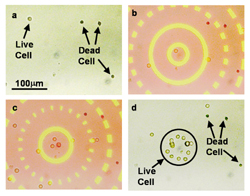
The images above show selective collection of live cells from a mixture of live and dead cells. In (a), the cells are randomly positioned. In (b) and (c), a series of optically projected concentric circles round up live cells, while dead cells (stained with Trypan blue dye) leak out through the dark gaps and are not collected. The optical pattern has a yellowish colour, while weak background scattered light results in a pinkish hue in the non-patterned areas. Section (d) shows the collection of live cells rounded up by the optoelectronic tweezer. (Courtesy of Wu Lab, UC Berkeley) Rounding up wayward cells and particles on a microscope slide can be as difficult as corralling wild horses on the range, particularly if there's a need to separate a single individual from the group.
But now, a new device developed by University of California, Berkeley, engineers, and dubbed an "optoelectronic tweezer," will enable researchers to easily manipulate large numbers of single cells and particles using optical images projected onto a glass slide coated with photoconductive materials.
"This is the first time a single light-emitting diode has been used to trap more than 10,000 microparticles at the same time," said Ming Wu, UC Berkeley professor of electrical engineering and computer sciences and principal investigator of the study. "Optoelectronic tweezers can produce instant microfluidic circuits without the need for sophisticated microfabrication techniques."