

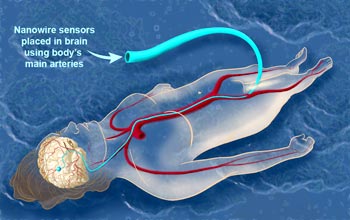
Neuroscientist Rudolfo Llinas and his colleagues envision an entire array of nanowires being connected to a catheter tube, which could then be guided through the circulatory system to the brain. Once there, the nanowires would spread into a kind of bouquet, branching out into tinier and tinier blood vessels until they reached specific locations. Each nanowire would then be used to record the electrical activity of a single nerve cells, or small groups of nerve cells. (Credit: Zina Deretsky, National Science Foundation)Working with platinum nanowires 100 times thinner than a human hair--and using blood vessels as conduits to guide the wires--a team of U.S. and Japanese researchers has demonstrated a technique that may one day allow doctors to monitor individual brain cells and perhaps provide new treatments for neurological diseases such as Parkinson's.

| Biotechnology | July 15, 2005 08:04 PM |
| Full story | 0 Comments | 5399 views |

| Health & Medicine | July 15, 2005 08:03 PM |
Delving deep into the molecular subtleties of a strain of mice engineered to age rapidly, scientists have found that an accumulation of genetic mutations prompts a cascade of programmed cell death that seems to underpin the aging process.
| Full story | 0 Comments | 4364 views |
| Health & Medicine | July 15, 2005 08:02 PM |
Researchers at the University of Minnesota were able to reverse memory loss in mice with significant brain degeneration for the first time, a breakthrough that offers hope to the estimated 4 million people living with Alzheimer's disease.
| Full story | 0 Comments | 5759 views |

| Molecular & Cell Biology | July 15, 2005 08:00 PM |
Researchers have constructed a new detailed map of the three-dimensional terrain of a synapse -- the junction between neurons which are critical for communication in the brain and nervous system. The "nano-map," which shows the tiny spines and valleys resolved at nanometer scale, or one-billionth of a meter, has already proven its worth in changing scientists' views of the synaptic landscape.
| Full story | 0 Comments | 4506 views |
| Molecular & Cell Biology | July 15, 2005 07:58 PM |
Scientists have begun to clarify how one of the body's molecules controls the trafficking of T cells through the blood, lymph nodes and on to tissues to fight infection -- a crucial response that sometimes goes awry, attacking the body's own tissues and causing autoimmune diseases.
| Full story | 0 Comments | 3721 views |
| Molecular & Cell Biology | July 15, 2005 07:57 PM |
Howard Hughes Medical Institute researchers have discovered a novel way in which the brain size of developing mammals may be regulated. They have identified a signaling pathway that controls the orientation in which dividing neural progenitor cells are cleaved during development.
| Full story | 0 Comments | 4357 views |

| Environment | July 15, 2005 07:55 PM |
Seabirds are the surprising culprits in delivering pollutants – through their guano – to seemingly pristine northern ecosystems, a new Canadian study shows.
| Full story | 0 Comments | 4123 views |

- In some genetic cases of microcephaly, stem cells fail to launch
- Yale team discovers how Zika virus causes fetal brain damage
- Scientists uncover the way a common cell enzyme alerts the body to invading bacteria
- Arctic gives clues on worst mass extinction of life
- Calcium channel blockers caught in the act at atomic level
Search Bio News Net
Free Biology Newsletter
- Flexibility That A.C.A. Lent to Work Force Is Threatened by...International Herald Tribune
- Bacteria Behind Legionnaires’ Disease Found at New York Police StationInternational Herald Tribune
- Prescription Price Crisis? 28 Million Americans See Spike in Drug...MSNBC.com: Health
- Seizing on Opioid Crisis, a Drug Maker Lobbies Hard for...International Herald Tribune
- Republicans are taking a big political risk on health careAP Health News
- Why We're So Divided Over Saving WolvesNational Geographic News