


Scientists have identified the first reported case in Asia of primate-to-human transmission of simian foamy virus (SFV), a retrovirus found in macaques and other primates that so far has not been shown to cause disease in humans. The transmission of the virus from a monkey to a human took place at a monkey temple in Bali, Indonesia, the researchers report in the July issue of the journal Emerging Infectious Diseases. Even though this particular virus jumping to humans may not prove dangerous, the scientists warn that the dense human and primate populations in Asia could lead to other primate-borne viruses jumping the species barrier and causing human disease.

| Biology | July 14, 2005 08:04 PM |
What could the fierce dinosaur T. rex and a modern songbird such as the sparrow possibly have in common? Their pulmonary systems may have been more similar than scientists previously thought, according to new research from Ohio University and Harvard University.
| Full story | 0 Comments | 7049 views |

| Molecular & Cell Biology | July 14, 2005 07:59 PM |
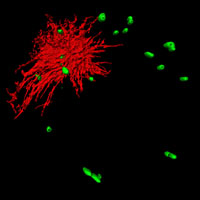
A three dimensional reconstruction of a dividing oocyte showing that the microtubules [red] are too short to reach all the chromosomes [green].Microtubules need a helping hand to find chromosomes in dividing egg cells, scientists have discovered. Although it was generally accepted that microtubules act alone as the cellular ropes to pull chromosomes into place, a new study by researchers at the European Molecular Biology Laboratory (EMBL) shows that this is not the case. They found that in large cells such as animal eggs, something else is needed to move the chromosomes into the correct location - fibres of the cytoskeletal molecule actin (Nature, July 13, 2005).
| Full story | 0 Comments | 5830 views |

| Environment | July 14, 2005 07:58 PM |
Organic farming produces the same yields of corn and soybeans as does conventional farming, but uses 30 percent less energy, less water and no pesticides, a review of a 22-year farming trial study concludes.
| Full story | 2 Comments | 9280 views |
| Molecular & Cell Biology | July 14, 2005 07:57 PM |
Researchers at the University of Minnesota Cancer Center and the National Cancer Institute (NCI), part of the National Institutes of Health, have discovered a new method that could accelerate the way cancer-causing genes are found and could lead to a more accurate identification of the genes, according to two studies in the July 14, 2005, issue of Nature.
| Full story | 0 Comments | 4863 views |
| Molecular & Cell Biology | July 14, 2005 07:56 PM |
Nerve cells relay messages at blink-of-the-eye speeds by squirting chemicals called neurotransmitters across tiny gaps called synapses to awaiting message receptors. But lots of different receptors and neurotransmitters work simultaneously. Which goes where to send the proper message?
| Full story | 0 Comments | 4597 views |
| Biology | July 14, 2005 07:53 PM |
 Men! Fed up with women faking headaches? Grant yourself lucky that you are not a mosquito fish, as females wouldn't think twice about attacking you when you make a pass at them. As they are not keen on intercourse, females select for strong male genes by attacking those that show them some interest. Therefore, the lucky (it's often the little) one sneaks up from behind, quickly retracting after copulation to prevent a nasty blast.
| Full story | 0 Comments | 6238 views |
| Molecular & Cell Biology | July 14, 2005 07:52 PM |
Each year, 200,000 Americans find out that the largest blood vessel in their body, the aorta, may burst open at any time. About 20,000 die suddenly from such a rupture. And another 36,000 have surgery to repair or replace the swelling section of aorta before time runs out.
| Full story | 0 Comments | 4731 views |

| Health & Medicine | July 14, 2005 07:51 PM |
A Vaccine for pigs could help save the 50,000 people a year in poor countries killed by a gruesome parasite. Initial trials suggest it is nearly 100 per cent effective.
| Full story | 0 Comments | 8142 views |

| Stem Cell Research | July 14, 2005 07:49 PM |
Stem cell research – including research involving human embryonic stem cells – is essential to the advancement of cancer research, according to a position statement adopted by the Board of Directors of the American Association for Cancer Research.
| Full story | 0 Comments | 4043 views |
| Molecular & Cell Biology | July 14, 2005 07:46 PM |
Researchers at the San Francisco VA Medical Center (SFVAMC) and the University of California, San Francisco (UCSF) have identified six genes associated with lymphocytic bronchitis, which is thought to lead to obliterative bronchitis (OB), the most common cause of long-term failure of transplanted lungs.
| Full story | 0 Comments | 4795 views |

- In some genetic cases of microcephaly, stem cells fail to launch
- Yale team discovers how Zika virus causes fetal brain damage
- Scientists uncover the way a common cell enzyme alerts the body to invading bacteria
- Arctic gives clues on worst mass extinction of life
- Calcium channel blockers caught in the act at atomic level
Search Bio News Net
Free Biology Newsletter
- Flexibility That A.C.A. Lent to Work Force Is Threatened by...International Herald Tribune
- Bacteria Behind Legionnaires’ Disease Found at New York Police StationInternational Herald Tribune
- Prescription Price Crisis? 28 Million Americans See Spike in Drug...MSNBC.com: Health
- Seizing on Opioid Crisis, a Drug Maker Lobbies Hard for...International Herald Tribune
- Republicans are taking a big political risk on health careAP Health News
- Why We're So Divided Over Saving WolvesNational Geographic News