Biology News Net
RSS 2.0 Feed
General
GeneralJuly 8, 2005 05:25 PM

I'll be away for the weekend, so I posted sunday and saturday news for today (I usually spread the week's news on the weekend, since press release are posted monday-friday). I can't use future posting as usual, as movable type (the platform I use) is experiencing a conflict with a cPanel module. The issue is resolved, and my server will auto-update tonight, but it'll be a bit late!

Good Weekend!

0 Comments 5294 views
Biology

mbari070705.1.jpg
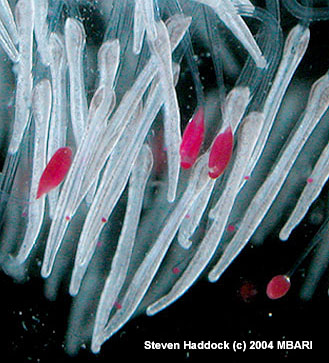
This photograph shows the newly discovered siphonophore's tentilla—tiny filaments that branch off the main tentacles. Each tentilla contains thousands of stinging cells. The red lures are on separate stalks, which move up and down, causing the lures to wiggle like swimming copepods (a typical food of small midwater fishes). Image: Steven Haddock (c) 2004 MBARI
Editor : Other images are available

As successful fishermen know, if you want to catch fish, you have to use the right bait or lure. This is true even in the deep sea, where scientists recently discovered a new species of jelly that attracts fish by wiggling hundreds of glowing red lures. This is the first time any marine invertebrate has been found to use a bioluminescent lure or to display red bioluminescence. This discovery is described in an article written by Steven Haddock of the Monterey Bay Aquarium Research Institute (MBARI), along with several coauthors, in the July 8, 2005 issue of Science magazine.

Biology

brandeis070805.1sm.jpg
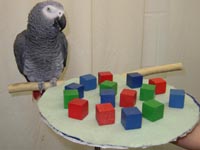
A Brandeis University researcher has shown that an African grey parrot with a walnut-sized brain understands a numerical concept akin to zero – an abstract notion that humans don't typically understand until age three or four, and that can significantly challenge learning-disabled children

Environment

For asthmatics and for anyone with respiratory problems, air pollution can significantly impair simple everyday activities. NASA is trying to tie together satellites and stations on the ground to develop a "sensor web" to track this pollution and improve air quality forecasts.

Biology

Identical twins lose some fundamental similarities as they grow older, a new study reports.

Environment

The Gulf of Mexico, 130 miles south of Galveston, Texas -- An international team of marine research scientists working for the Integrated Ocean Drilling Program (IODP) have found new evidence that links catastrophic sand avalanches in deep Gulf waters to rapid sea level changes. By analyzing downhole measurements and freshly retrieved sediment cores, IODP scientists are reconstructing the history of a basin formed approximately 20,000 years ago, when sea level fell so low that the Texas shoreline shifted almost 100 miles to the south. The data are important to reconstructing climate change history and gathering insights about the development and placement of natural resources, particularly gas and oil deposits.

Biotechnology

Scientists have shown for the first time that carbon nanotubes make an ideal scaffold for the growth of bone tissue. The new technique could change the way doctors treat broken bones, allowing them to simply inject a solution of nanotubes into a fracture to promote healing.

Biology

Researchers at Harvard University have found evidence that the retina actively seeks novel features in the visual environment, dynamically adjusting its processing in order to seek the unusual while ignoring the commonplace. The scientists report in this week's issue of the journal Nature on their finding that this principle of novelty-detection operates in many visual environments.

Biology

A trail of feathers led a team of Purdue University scientists to confirm that eagles from central Asia are quite possibly the most faithful of birds.

Microbiology

The HIV virus hides out in the very immune system cells that are meant to protect the body from viral infection. But how does it prevent these cells from mounting a full-scale attack against the invader? In research published today in the Journal of Clinical Investigation, a team at the Weizmann Institute of Science has shown how a part of a protein on the virus' outer surface interferes with the cells' normal immune response. But their work may have wider implications: this molecular fragment, which has such a devastating effect in one disease, might turn out to be an effective treatment for other disorders such as rheumatoid arthritis.

Environment

Massive extinctions of animals and the arrival of the first humans in ancient Australia may be linked, according to scientists at the Carnegie Institution, University of Colorado, Australian National University, and Bates College.* The extinctions occurred 45,000 to 55,000 years ago. The researchers traced evidence of diet and the environment contained in ancient eggshells and wombat teeth over the last 140,000 years to reconstruct what happened. The remains showed evidence of a rapid change of diet at the time of the extinctions. The researchers believe that massive fires set by the first humans may have altered the ecosystem of shrubs, trees, and grasses to the fire-adapted desert-scrub of today. The work is published in the July 8, issue of Science.

Molecular & Cell Biology

A signaling pathway required for plants to grow to their normal size appears to have an unexpected dual purpose of keeping the plant from wallpapering itself with too many densely clustered stomata.