
Biology News Net
RSS 2.0 Feed
Biology


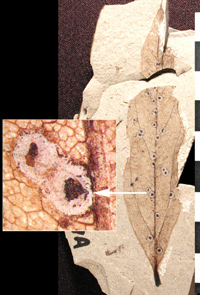
Fossil leaf in the laurel family with over 30 examples of probable fairy moth feeding, from Laguna del Hunco in Patagonia, Argentina (52 Myr). Note leaf cases at centers of damaged areas.
South America has the most biodiversity of any major region today and according to an international team of researchers, that biodiversity began at least 52 million years ago.

"What defines terrestrial ecology is plant insect interactions," says Dr. Peter Wilf, assistant professor of geosciences and the John T. Ryan Jr. Faculty Fellow. "But there is very little information about the history of insects eating plants in South America, despite the tremendous number of plant and animal species there today. This study provides the first window to the past on the South American continent's ancient diversity and abundance of insects on plants 52 million years ago. This ancient biodiversity is a legacy that will help us understand today's South American diversity."

Environment

Growing desertification worldwide threatens to swell by millions the number of poor forced to seek new homes and livelihoods. And a rising number of large, intense dust storms plaguing many areas menace the health of people even continents away, international experts warn in a new report.

Health & Medicine

Twelve women recently completed 60 days of voluntary bedrest in order to simulate the physiological effects of weightlessness on the human body. The research team in Toulouse, France, is now actively seeking twelve new volunteers to enable them to continue and enhance the research.

Stem Cell Research

The most common form of lung cancer may begin in a group of newly isolated lung stem cells, according to researchers from the Howard Hughes Medical Institute.

Working in a mouse model, the researchers isolated a novel type of lung cell that can divide into fresh copies of itself and into the two more specialized kinds of cells deep in the lung. Their experiments show that at the earliest stage of tumor development, the stem cell appears to be the first lung cells that respond to a cancer-causing mutation. The newly identified cell type fulfills all but one of the strictest criteria that scientists look for in defining adult stem cells.

Molecular & Cell Biology

Nature is a seemingly endless storehouse of interesting – and potentially life-saving – biological molecules. But tracking down and harvesting those chemicals in their natural form can be time-consuming, expensive and unreliable.

Now Salk scientists have discovered a new way of bringing “bio-prospecting” out of the rainforest and into the lab. Their findings are published in the June 16th edition of the journal Nature.

Stem Cell Research

For the first time ever, an advanced training program that teaches how to create and maintain embryonic stem cell lines will be offered outside of the University of Pittsburgh, where it originated in 2003. The weeklong course on these all-purpose cells, which can develop into any of the tissue in the adult body, will run June 15-23 at the James H. Clark Center at the Stanford University School of Medicine.

Molecular & Cell Biology

A missing receptor molecule contributes to the growth of tumors in human ovaries. This surprisingly evident connection has now been proven by a team at the Medical University of Vienna, who published their data in the science journal Molecular Cancer Research. The team, who is supported by funding from the Austrian Science Fund FWF, also discovered the possible genetic reason why the receptor molecule, which is an important factor in regulating cell growth, is missing.

Biotechnology

University of Michigan scientists have created the nanotechnology equivalent of a Trojan horse to smuggle a powerful chemotherapeutic drug inside tumor cells – increasing the drug's cancer-killing activity and reducing its toxic side effects.