

About 14,000 years ago - a few hundred thousand years after our putative modern forebears spread out from Africa - descendants of archaic humans crossed the Bering land bridge from Siberia to North America. Several lines of evidence support this model, but that's where the consensus ends and the details are hotly debated. In a paper published in the premier open-access journal PLoS Biology, Jody Hey now reveals how the sizes of the first New World populations have changed since they were founded. His new approach shows that the New World was colonized by a surprisingly small population with an effective size of only about 70 individuals (those individuals likely to contribute genes to the next generation).

| Biology | May 24, 2005 06:49 PM |
Researchers recently discovered a gene essential to one of the plant kingdom's key immune responses--programmed cell death (PCD). Plants use PCD to create a protective zone of dead cells around the infection site to prevent the invading pathogen from spreading. But how the plants keep from killing themselves after they turn on the cell-suicide process was a mystery.
| Full story | 0 Comments | 5802 views |

| Biotechnology | May 24, 2005 06:46 PM |
The simple marine sponge is inspiring cutting-edge research in the design of new materials at the University of California, Santa Barbara.
A report about these exciting new results involving the use of gold nanoparticles is the cover story of the current issue of the scientific journal, Advanced Materials. The article is written by Daniel E. Morse, professor of molecular, cellular and developmental biology at UCSB, and director of the Institute for Collaborative Biotechnologies, and his research group. The authors include postdoctoral fellow, David Kisailus (first author), and graduate students Mark Najarian and James C. Weaver.
| Full story | 0 Comments | 4252 views |

| Molecular & Cell Biology | May 24, 2005 06:45 PM |
In certain parts of the brain, cells called neurons go through a cycle of death and replenishment. New research from Rockefeller University's Fernando Nottebohm, Ph.D., shows that these replaceable neurons share something in common with the neurons that die in people with diseases such as Alzheimer's and Parkinson's: both have unusually low levels of a protein called UCHL1.
| Full story | 0 Comments | 4384 views |

| Health & Medicine | May 24, 2005 06:42 PM |
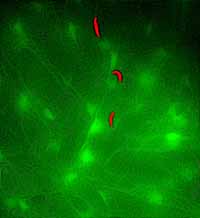
Tagged with red fluorescent protein, the malarial parasites in the sporozoite stage can be seen migrating along the sinusoids in a mouse liver. (Photo: Ute Frevert et al.)Despite the efforts of governments and the World Health Organization to combine prevention measures and efforts to eradicate malaria-carrying mosquitoes, the disease kills more than a million people each year. Much is known about the microbes that cause the disease, tiny parasites of the genus Plasmodium, which have a complex life cycle involving several distinct phases and habitats. But, many details of the organism's life cycle, including a critical stage in the parasite's life cycle – invasion of the liver - have escaped direct observation until now. In their new study published in the open-access journal PLoS Biology, Ute Frevert et al. used intravital microscopy - which allows direct observation of events in a living animal - to study the discrete steps that facilitate the parasites' entry into the liver.
| Full story | 0 Comments | 4333 views |

| Environment | May 24, 2005 06:40 PM |
Sacrificing one wetland for the sake of five others may be the way to go when planning constructed wetlands to replace those destroyed during road building, but a Penn State Erie biologist is monitoring the salinity of the wetlands to see how the salt affects animals and insects.
| Full story | 0 Comments | 6764 views |
| Biology | May 24, 2005 06:38 PM |
Using the human genome sequence annotation, high-throughput cloning methodologies, and automation, a group at the Harvard Institute of Proteomics lead by Leonardo Brizuela (Harvard Medical School lecturer on biological chemistry and molecular pharmacology) mined public databases to collect the sequence information of all identified human kinase genes and have built a gene repository for this gene class. Their work is described in the online early edition of Proceedings of the National Academy of Sciences and demonstrates uses of the collection in cellular and biochemical assays.
| Full story | 0 Comments | 4489 views |
| Health & Medicine | May 24, 2005 06:35 PM |
Researchers at University of California, San Diego (UCSD) have found that Lafora disease, an inherited form of epilepsy that results in death by the age of 30, can be caused by mutations in a gene that regulates the concentration of the protein laforin. These findings are reported in the current issue of Proceedings of the National Academy of Sciences (PNAS).
| Full story | 0 Comments | 3878 views |
| Biology | May 24, 2005 06:29 PM |
Neurobiologists have discovered a specialized night-vision brain area in night-migratory songbirds. They believe the area might enable the birds to navigate by the stars, and to visually detect the earth's magnetic field through photoreceptor molecules, whose light-sensitivity is modulated by the field.
| Full story | 0 Comments | 4709 views |

- In some genetic cases of microcephaly, stem cells fail to launch
- Yale team discovers how Zika virus causes fetal brain damage
- Scientists uncover the way a common cell enzyme alerts the body to invading bacteria
- Arctic gives clues on worst mass extinction of life
- Calcium channel blockers caught in the act at atomic level
Search Bio News Net
Free Biology Newsletter
- Flexibility That A.C.A. Lent to Work Force Is Threatened by...International Herald Tribune
- Bacteria Behind Legionnaires’ Disease Found at New York Police StationInternational Herald Tribune
- Prescription Price Crisis? 28 Million Americans See Spike in Drug...MSNBC.com: Health
- Seizing on Opioid Crisis, a Drug Maker Lobbies Hard for...International Herald Tribune
- Republicans are taking a big political risk on health careAP Health News
- Why We're So Divided Over Saving WolvesNational Geographic News