

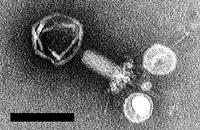
Despite a striking resemblance to an E. coli virus, this marine virus appears to have evolved genes adapted to infecting photosynthetic bacteria inhabiting low nutrient oceans. (Scale bar indicates 100 nm) (Image: Peter Weigele)Cyanobacteria exert a disproportionate influence on their planet for their size. The Prochlorococcus group of cyanobacteria account for a large fraction of global photosynthesis by virtue of their ubiquitous presence in nutrient-depleted ocean waters. Even tinier agents - the viruses that infect these bacteria, called cyanophages - appear capable of wielding surprising influence on global cycles by affecting the population dynamics and evolutionary path of Prochlorococcus. An investigation of the genetic makeup of three cyanophages in the freely-available online journal PLoS Biology helps reveal the complex role these phages might have on our great planetary cycles.

| Microbiology | April 19, 2005 05:41 PM |
| Full story | 0 Comments | 9245 views |

| Environment | April 19, 2005 05:37 PM |

ASAR image shows Drygalski crackMaps of Antarctica need to be amended. The long-awaited collision between the vast B-15A iceberg and the landfast Drygalski ice tongue has taken place. This Envisat radar image shows the ice tongue – large and permanent enough to feature in Antarctic atlases - has come off worst.
An image acquired by Envisat on 15 April 2005 shows that a five-kilometre-long section at the seaward end of Drygalski has broken off following a collision with the drifting B-15A. The iceberg itself appears so far unaffected. With more than half the iceberg still to clear the floating pier of ice, Drygalski may undergo more damage in coming days. It is an old philosophical paradox: what happens when an irresistible force meets an immovable object? For the past few months, ESA's Envisat satellite has been watching an answer play out in ice, as the B-15A iceberg converged on the Drygalski ice tongue.
| Full story | 0 Comments | 6839 views |

| Biology | April 19, 2005 05:36 PM |
Reconsider relocating aquarium fish into your backyard pond. Restrain yourself from ordering exotic pets off the Internet, no matter how interesting they might look in the pictures. And vote for politicians that encourage sound port inspection. Because, according to recent Proceedings of the National Academy of Sciences article by Drs. Jonathan M. Jeschke and David L. Strayer, our best defense in combating invasive animals is ensuring that they don't infiltrate our natural areas in the first place.
| Full story | 0 Comments | 4537 views |

| Molecular & Cell Biology | April 19, 2005 05:35 PM |
New research in mice provides more evidence that a brief bout of stress can give the immune system a beneficial boost – under certain conditions.
Laboratory results showed that acute stress – stress that lasts for minutes to hours – temporarily mobilized all major types of immune cells, or leukocytes to potential battle stations in the body. In certain situations, this stress-induced boost in the number of immune cells may be advantageous, as leukocytes fight infections and other diseases.
| Full story | 0 Comments | 3979 views |

| Health & Medicine | April 19, 2005 05:33 PM |
A small trial testing the safety of an experimental vaccine targeting West Nile virus (WNV) opened today at the National Institutes of Health's (NIH) Clinical Center in Bethesda, MD. The vaccine, which will be tested first in 15 healthy adult volunteers, was developed for human clinical studies by researchers at the National Institute of Allergy and Infectious Diseases' (NIAID) Vaccine Research Center (VRC), and Vical Inc., San Diego, based on an animal vaccine tested at the Centers for Disease Control and Prevention (CDC). Vical also manufactures the experimental vaccine.
| Full story | 0 Comments | 5392 views |
| Microbiology | April 19, 2005 05:32 PM |
At one time, scientists wondered whether life existed in the deep recesses of the world’s oceans. What kinds of creatures, they wondered, could withstand the dark, cold and extreme pressure of such an environment?
Researchers at Scripps Institution of Oceanography at the University of California, San Diego, and their colleagues have used innovations in genomics research to begin to develop an accurate portrayal of deep sea life forms and how they survive in the harsh conditions of the marine abyss.
| Full story | 0 Comments | 4965 views |
| Microbiology | April 19, 2005 05:31 PM |
Scientists have identified good bacteria already living in some humans that target and trap HIV and may protect against infection. They report their findings today at the 2005 American Society for Microbiology Beneficial Microbes Conference.
| Full story | 0 Comments | 5050 views |
| Health & Medicine | April 19, 2005 05:29 PM |
A study comparing, for the first time, breast cancers from Nigeria, Senegal and North America has found that women of African ancestry are more likely to be diagnosed with a more virulent form of the disease than women of European ancestry.
Researchers from the University of Chicago, working with colleagues at the University of Calabar in Nigeria and the University of North Carolina, found that breast cancers in African women produce a different pattern of gene expression. Tumors from African women -- from three locations in Nigeria and one in Senegal -- are more likely to originate from a different group of cells within the breast and often do not present the molecular targets that form the basis of many standard therapies.
| Full story | 0 Comments | 5133 views |
| Health & Medicine | April 19, 2005 05:27 PM |
Compounds found in plastic products used to wrap or contain food and beverages have aroused concerns as possible cancer-causing agents because they can sometimes leach out of the plastic and migrate into the food, especially after heating or when the plastic is old or scratched. In two studies funded by the National Institute of Environmental Health Sciences, researchers at Fox Chase Cancer Center in Philadelphia have demonstrated that two plasticizer compounds, BPA and BBP, are environmental estrogens capable of affecting gene expression in the mammary glands of young female laboratory rats exposed to the compounds through their mothers' milk.
| Full story | 1 Comment | 7549 views |

- In some genetic cases of microcephaly, stem cells fail to launch
- Yale team discovers how Zika virus causes fetal brain damage
- Scientists uncover the way a common cell enzyme alerts the body to invading bacteria
- Arctic gives clues on worst mass extinction of life
- Calcium channel blockers caught in the act at atomic level
Search Bio News Net
Free Biology Newsletter
- Flexibility That A.C.A. Lent to Work Force Is Threatened by...International Herald Tribune
- Bacteria Behind Legionnaires’ Disease Found at New York Police StationInternational Herald Tribune
- Prescription Price Crisis? 28 Million Americans See Spike in Drug...MSNBC.com: Health
- Seizing on Opioid Crisis, a Drug Maker Lobbies Hard for...International Herald Tribune
- Republicans are taking a big political risk on health careAP Health News
- Why We're So Divided Over Saving WolvesNational Geographic News