

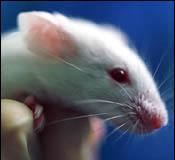
A laboratory mouse.Newborn mice and dogs with hemophilia A were restored to normal health through gene therapy developed by researchers at Washington University School of Medicine in St. Louis. The technique introduced into the animals' cells a gene that makes clotting factor VIII, a protein missing because of a genetic defect. "We are really pleased with the results, because the animals produced about 20 times more factor than has been achieved in prior attempts using gene therapy for hemophilia A in dogs," says senior author Katherine Parker Ponder, M.D., associate professor of medicine and of biochemistry and molecular biophysics.

| Gene Therapy | April 18, 2005 06:32 PM |
| Full story | 0 Comments | 17897 views |

| Microarray | April 18, 2005 05:02 PM |
A new study is providing scientists with a better understanding of why some pediatric acute lymphoblastic leukemia (ALL) patients fail to respond to treatment even when existing clinical predictive criteria point towards a positive treatment outcome. The research, published in the April issue of Cancer Cell, is likely to facilitate development of new strategies to combat drug resistance and treatment failure for children with ALL.
| Full story | 0 Comments | 6104 views |

| Health & Medicine | April 18, 2005 05:01 PM |
In mouse models of intestinal cancer, use of an anti-inflammatory drug eliminated all of the cancer-causing risks produced by a high-fat Western-style diet - even when several genetic brakes to cancer formation were missing in the animals, say researchers from the Albert Einstein Cancer Center.
| Full story | 0 Comments | 5100 views |

| Biology | April 18, 2005 04:59 PM |
The ones that stay and the ones that stray are biological puzzles among Pacific salmon, of whom the vast majority – but not all – travel thousands of miles to sea and back to the streams where they hatched.
| Full story | 0 Comments | 3923 views |

| Environment | April 18, 2005 04:58 PM |
An ambitious plan is under way in the ecological community to agree a set of standards for ecologically successful river restoration. The plan is being led by the British Ecological Society's Journal of Applied Ecology, which this month is publishing a special profile on river restoration. Opening the debate is a paper by 22 leading US river ecologists proposing five criteria for ecologically successful river restoration. Their aim is to arrive at an agreed set of standards which would eventually be endorsed by the United Nations Environment Programme.
| Full story | 0 Comments | 4440 views |
| Environment | April 18, 2005 04:56 PM |
Major changes need to be made to the way ski pistes are managed if delicate alpine plants are to be protected, ecologists have warned. According to new research published today in the British Ecological Society's Journal of Applied Ecology, machine grading and artificial snow production is causing significant changes in the number and type of plant species in the European Alps.
| Full story | 0 Comments | 5051 views |
| Biology | April 18, 2005 04:54 PM |
Ocean warming has a negative impact on the condition of elephant seals, reveals a study published in the Open Access journal BMC Biology. High ocean temperatures observed from 1975 to the late 1990s are correlated with a 28% decrease in the weight of elephant seal pups. Elephant seals are shown to be sensitive to ocean temperature changes associated with both long-term 25-year cycles and short-term 3-4 year cycles such as those caused by El Niño.
| Full story | 1 Comment | 8094 views |
| Health & Medicine | April 18, 2005 04:52 PM |
Researchers at The University of Texas M. D. Anderson Cancer Center have developed a way to test whether the new targeted therapy Tarceva and the widely used chemotherapy drug Taxol are effectively killing tumor cells. They say that with further refinement, the test may make it possible to accurately assess whether patients are responding to these agents, as well as potentially others, within days of beginning therapy.
| Full story | 0 Comments | 4493 views |
| Health & Medicine | April 18, 2005 04:50 PM |
Preliminary results from a large, randomized clinical trial for patients with previously untreated recurrent or metastatic breast cancer — cancer that has spread from the breast to other parts of the body — show that those patients who received bevacizumab (Avastin™) in combination with standard chemotherapy had a longer time period before their cancer progressed than patients who received the same chemotherapy without bevacizumab.
| Full story | 0 Comments | 4257 views |

- In some genetic cases of microcephaly, stem cells fail to launch
- Yale team discovers how Zika virus causes fetal brain damage
- Scientists uncover the way a common cell enzyme alerts the body to invading bacteria
- Arctic gives clues on worst mass extinction of life
- Calcium channel blockers caught in the act at atomic level
Search Bio News Net
Free Biology Newsletter
- Flexibility That A.C.A. Lent to Work Force Is Threatened by...International Herald Tribune
- Bacteria Behind Legionnaires’ Disease Found at New York Police StationInternational Herald Tribune
- Prescription Price Crisis? 28 Million Americans See Spike in Drug...MSNBC.com: Health
- Seizing on Opioid Crisis, a Drug Maker Lobbies Hard for...International Herald Tribune
- Republicans are taking a big political risk on health careAP Health News
- Why We're So Divided Over Saving WolvesNational Geographic News