

Nora Besansky, O'Hara Professor of Biological Sciences at the University of Notre Dame and a member of the University's Eck Institute for Global Health, has led an international team of scientists in sequencing the genomes of 16 Anopheles mosquito species from around the world.

| Health & Medicine | November 27, 2014 06:36 PM |
People affected by a common inherited form of autism could be helped by a drug that is being tested as a treatment for cancer.
| Full story | 0 Comments | 8566 views |
| Health & Medicine | November 26, 2014 07:23 PM |
Researchers from the Broad Institute of MIT and Harvard, Harvard Medical School, and Harvard-affiliated hospitals have uncovered an easily detectable, "pre-malignant" state in the blood that significantly increases the likelihood that an individual will go on to develop blood cancers such as leukemia, lymphoma, or myelodysplastic syndrome. The discovery, which was made independently by two research teams affiliated with the Broad and partner institutions, opens new avenues for research aimed at early detection and prevention of blood cancer. Findings from both teams appear this week in the New England Journal of Medicine.
| Full story | 0 Comments | 14220 views |

| Biotechnology | November 24, 2014 04:47 PM |
A team of scientists from Arizona State University's Biodesign Institute and IBM's T.J. Watson Research Center have developed a prototype DNA reader that could make whole genome profiling an everyday practice in medicine.
| Full story | 0 Comments | 7503 views |

| Biology | November 24, 2014 04:47 PM |
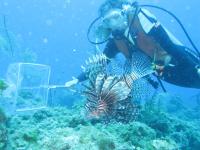
Stephanie Green studies lionfish in The Bahamas. If you live in lionfish territory in the Atlantic Ocean, the last thing you want to be is a small fish with a long, skinny body, resting by yourself at night, near the bottom of the seafloor.
| Full story | 0 Comments | 7447 views |

| Environment | November 20, 2014 06:24 PM |
Drawing on nearly five decades of experience, Professor Sir Ghillean Prance, one of the seminal scientific explorers of the Amazon rain forest in modern times, chronicles some of his most significant and fascinating expeditions in That Glorious Forest: Exploring the Plants and Their Indigenous Uses in Amazonia, now available from The New York Botanical Garden Press.
| Full story | 0 Comments | 6320 views |
| Biology | November 20, 2014 06:24 PM |
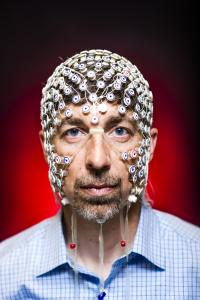
Electrical and computer engineering professor Barry Van Veen wears an electrode net used to monitor brain activity via EEG signals. As real as that daydream may seem, its path through your brain runs opposite reality.
| Full story | 0 Comments | 9488 views |

| Molecular & Cell Biology | November 19, 2014 06:18 PM |
Hox genes are master body-building genes that specify where an animal's head, tail and everything in between should go. There's even a special Hox gene program that directs the development of limbs and fins, including specific modifications such as the thumb in mice and humans. Now, San Francisco State University researchers show that this fin- and limb-building genetic program is also utilized during the development of other vertebrate features.
| Full story | 0 Comments | 6244 views |

| Microbiology | November 19, 2014 06:18 PM |
Microbiologists at NYU Langone Medical Center say they have what may be the first strong evidence that the natural presence of viruses in the gut -- or what they call the 'virome' -- plays a health-maintenance and infection-fighting role similar to that of the intestinal bacteria that dwell there and make up the "microbiome."
| Full story | 0 Comments | 6893 views |

| Bioinformatics | November 19, 2014 06:18 PM |
Looking across evolutionary time and the genomic landscapes of humans and mice, an international group of researchers has found powerful clues to why certain processes and systems in the mouse - such as the immune system, metabolism and stress response - are so different from those in people. Building on years of mouse and gene regulation studies, they have developed a resource that can help scientists better understand how similarities and differences between mice and humans are written in their genomes.
| Full story | 0 Comments | 8295 views |
| Molecular & Cell Biology | November 18, 2014 07:02 PM |
Although every person's DNA remains the same throughout their lives, scientists know that it functions differently at different ages.
| Full story | 0 Comments | 8150 views |
| Health & Medicine | November 18, 2014 07:02 PM |
Melbourne researchers have identified why some people with coeliac disease show an immune response after eating oats.
| Full story | 0 Comments | 6672 views |
| Health & Medicine | November 17, 2014 05:48 PM |
Organs can become significantly damaged during transplantation, but a new article published in the BJS (British Journal of Surgery) offers a protective strategy that could keep them safe and allow them to function optimally after the procedure.
| Full story | 0 Comments | 8712 views |
| Health & Medicine | November 17, 2014 05:48 PM |
Chronic myeloid leukemia develops when a gene mutates and causes an enzyme to become hyperactive, causing blood-forming stem cells in the bone marrow to grow rapidly into abnormal cells. The enzyme, Abl-kinase, is a member of the "kinase" family of enzymes, which serve as an "on" or "off" switch for many functions in our cells. In chronic myeloid leukemia, the hyperactive Abl-kinase is targeted with drugs that bind to a specific part of the enzyme and block it, aiming to ultimately kill the fast-growing cancer cell. However, treatments are often limited by the fact that the cancer cells can adapt to resist drugs. EPFL scientists have identified an alternative part of Abl-kinase on which drugs can bind and act with a reduced risk of drug resistance. Their work is published in Nature Communications.
| Full story | 0 Comments | 6309 views |
| Biotechnology | November 17, 2014 05:48 PM |
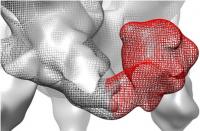
New techniques in electron microscope reveal new information about viruses, for example on the location of the variable V2 loop of HIV Env protein (red). This could give new insight... UC Davis researchers are getting a new look at the workings of HIV and other viruses thanks to new techniques in electron microscopy developed on campus.
| Full story | 0 Comments | 8445 views |
| Health & Medicine | November 12, 2014 05:48 PM |
Scientists have demonstrated for the first time that a single-dose, needleless Ebola vaccine given to primates through their noses and lungs protected them against infection for at least 21 weeks. A vaccine that doesn't require an injection could help prevent passing along infections through unintentional pricks. They report the results of their study on macaques in the ACS journal Molecular Pharmaceutics.
| Full story | 0 Comments | 9095 views |
| Environment | November 11, 2014 06:17 PM |
WCS scientists in the Democratic Republic of Congo (DRC) have discovered a new species of plant living in a remote rift valley escarpment that's supposed to be inside of a protected area. But an administrative mapping error puts the reserve's borders some 50 kilometers west of the actual location. Now the new species, along with 900 other plant varieties and 1,400 chimpanzees, are in limbo with no protection and threatened by cattle ranches and forest destruction.
| Full story | 0 Comments | 8370 views |
| Bioinformatics | November 10, 2014 07:28 PM |

Researchers at Washington University School of Medicine in St. Louis led an international team that sequenced and analyzed the cat genome to better understand the animal's domestication. Cats and humans have shared the same households for at least 9,000 years, but we still know very little about how our feline friends became domesticated. An analysis of the cat genome by researchers at Washington University School of Medicine in St. Louis reveals some surprising clues.
| Full story | 0 Comments | 12021 views |
| Health & Medicine | November 5, 2014 06:20 PM |
Although gluten-free foods are trendy among the health-conscious, they are necessary for those with celiac disease. But gluten, the primary trigger for health problems in these patients, may not be the only culprit. Scientists are reporting in ACS' Journal of Proteome Research that people with the disease also have reactions to non-gluten wheat proteins. The results could help scientists better understand how the disease works and could have implications for how to treat it.
| Full story | 0 Comments | 8204 views |
| Health & Medicine | November 5, 2014 06:20 PM |
Fatih Uckun, Jianjun Cheng and their colleagues have taken the first steps towards developing a so-called "smart bomb" to attack the most common and deadly form of childhood cancer — called B-lineage acute lymphoblastic leukemia (ALL).
| Full story | 0 Comments | 9121 views |
| Microbiology | November 4, 2014 06:42 PM |
Filoviruses like Ebola "edit" genetic material as they invade their hosts, according to a study published this week in mBio®, the online open-access journal of the American Society for Microbiology. The work, by researchers at the Icahn School of Medicine at Mount Sinai, the Galveston National Laboratory, and the J. Craig Venter Institute, could lead to a better understanding of these viruses, paving the way for new treatments down the road.
| Full story | 0 Comments | 11209 views |
| Health & Medicine | November 3, 2014 07:08 PM |
Some MRSA bugs in UK hospitals can be traced back to a type of bacteria found in farm animals, a study suggests.
| Full story | 0 Comments | 6420 views |
| Microbiology | November 3, 2014 07:08 PM |
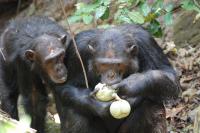
Chimpanzees are shown in Gombe Stream National Park. The microbes living in people's guts are much less diverse than those in humans' closest relatives, the African apes, an apparently long evolutionary trend that appears to be speeding up in more modern societies, with possible implications for human health, according to a new study.
| Full story | 0 Comments | 7396 views |

- In some genetic cases of microcephaly, stem cells fail to launch
- Yale team discovers how Zika virus causes fetal brain damage
- Scientists uncover the way a common cell enzyme alerts the body to invading bacteria
- Arctic gives clues on worst mass extinction of life
- Calcium channel blockers caught in the act at atomic level
Search Bio News Net
Free Biology Newsletter
- Flexibility That A.C.A. Lent to Work Force Is Threatened by...International Herald Tribune
- Bacteria Behind Legionnaires’ Disease Found at New York Police StationInternational Herald Tribune
- Prescription Price Crisis? 28 Million Americans See Spike in Drug...MSNBC.com: Health
- Seizing on Opioid Crisis, a Drug Maker Lobbies Hard for...International Herald Tribune
- Republicans are taking a big political risk on health careAP Health News
- Why We're So Divided Over Saving WolvesNational Geographic News