

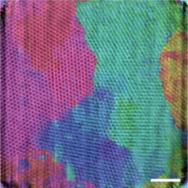
When you look very close up at a butterfly wing, you can see this patchwork map of lattices with slightly different orientations (colors added to illustrate the domains). Scientists used X-rays to discover what creates one butterfly effect: how the microscopic structures on the insect's wings reflect light to appear as brilliant colors to the eye.

| Molecular & Cell Biology | June 13, 2016 05:20 PM |
| Full story | 0 Comments | 6966 views |
| Molecular & Cell Biology | June 13, 2016 05:20 PM |
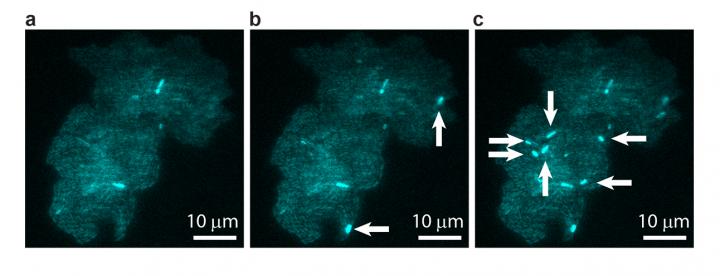
A bacterial colony showing individual cells undergoing transposable element events, resulting in blue fluorescence. "Jumping genes" are ubiquitous. Every domain of life hosts these sequences of DNA that can "jump" from one position to another along a chromosome; in fact, nearly half the human genome is made up of jumping genes. Depending on their specific excision and insertion points, jumping genes can interrupt or trigger gene expression, driving genetic mutation and contributing to cell diversification. Since their discovery in the 1940s, researchers have been able to study the behavior of these jumping genes, generally known as transposons or transposable elements (TE), primarily through indirect methods that infer individual activity from bulk results. However, such techniques are not sensitive enough to determine precisely how or why the transposons jump, and what factors trigger their activity.
| Full story | 0 Comments | 5902 views |
| Molecular & Cell Biology | June 13, 2016 05:20 PM |
Biologically speaking, we carry the outside world within us. The food we ingest each day and the trillions of microbes that inhabit our guts pose a constant risk of infection--and all that separates us from these foreign entities is a delicate boundary made of a single layer of cells.
| Full story | 0 Comments | 6167 views |

- In some genetic cases of microcephaly, stem cells fail to launch
- Yale team discovers how Zika virus causes fetal brain damage
- Scientists uncover the way a common cell enzyme alerts the body to invading bacteria
- Arctic gives clues on worst mass extinction of life
- Calcium channel blockers caught in the act at atomic level
Search Bio News Net
Free Biology Newsletter
- Flexibility That A.C.A. Lent to Work Force Is Threatened by...International Herald Tribune
- Bacteria Behind Legionnaires’ Disease Found at New York Police StationInternational Herald Tribune
- Prescription Price Crisis? 28 Million Americans See Spike in Drug...MSNBC.com: Health
- Seizing on Opioid Crisis, a Drug Maker Lobbies Hard for...International Herald Tribune
- Republicans are taking a big political risk on health careAP Health News
- Why We're So Divided Over Saving WolvesNational Geographic News