

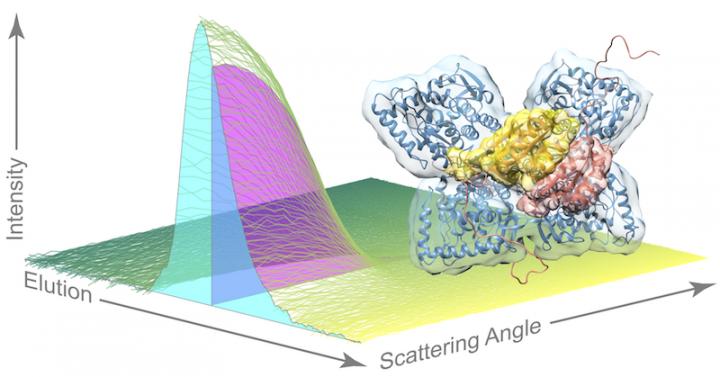
Stylized graphic of SEC-SAXS data (with cyan cross-section showing the elution profile and magenta cross-section showing scattering profile) and the structure of the activated phenylalanine hydroxylase Using a powerful combination of techniques from biophysics to mathematics, researchers have revealed new insights into the mechanism of a liver enzyme that is critical for human health. The enzyme, phenylalanine hydroxylase, turns the essential amino acid phenylalanine -- found in eggs, beef and many other foods and as an additive in diet soda -- into tyrosine, a precursor for multiple important neurotransmitters.

| Molecular & Cell Biology | May 25, 2016 05:44 PM |
| Full story | 0 Comments | 6104 views |
| Molecular & Cell Biology | May 25, 2016 05:44 PM |
A new study from MIT neuroscientists reveals that a gene mutation associated with autism plays a critical role in the formation and maturation of synapses -- the connections that allow neurons to communicate with each other.
| Full story | 0 Comments | 6449 views |

| Bioinformatics | May 25, 2016 05:44 PM |

This image shows a range of vertebrate the G10K members are working on: Bird - Ruby-throated Hummingbird; Reptile - Green Anole; Fish - Spotted Gar; Mammal - Koala The Genome Analysis Centre (TGAC) are to hold the biannual Genome 10K Conference on 29 August - 1 September 2017.
| Full story | 0 Comments | 6423 views |

| Health & Medicine | May 25, 2016 05:44 PM |
The National Myelodysplastic Syndromes Natural History Study (The National MDS Study) is underway, the ECOG-ACRIN Cancer Research Group and its collaborators announced today. This new study, funded by the National Institutes of Health's National Heart, Lung, and Blood Institute (NHLBI), and performed in collaboration with the National Cancer Institute (NCI), will collect detailed information and biological samples from 2000 adults with myelodysplastic syndromes (MDS) and 500 more patients receiving care for a persistent low red blood cell count (anemia) that cannot be explained. Its purpose is to build a national resource to be used by scientists in future research.
| Full story | 0 Comments | 5622 views |
| Molecular & Cell Biology | May 25, 2016 05:44 PM |
Unlike aspirin, bone marrow doesn't come with a neatly printed label with dosage instructions. However, a new study published in Cell Reports provides clues about how the dose of transplanted bone marrow might affect patients undergoing this risky procedure, frequently used to treat cancer and blood diseases.
| Full story | 0 Comments | 5586 views |

- In some genetic cases of microcephaly, stem cells fail to launch
- Yale team discovers how Zika virus causes fetal brain damage
- Scientists uncover the way a common cell enzyme alerts the body to invading bacteria
- Arctic gives clues on worst mass extinction of life
- Calcium channel blockers caught in the act at atomic level
Search Bio News Net
Free Biology Newsletter
- Flexibility That A.C.A. Lent to Work Force Is Threatened by...International Herald Tribune
- Bacteria Behind Legionnaires’ Disease Found at New York Police StationInternational Herald Tribune
- Prescription Price Crisis? 28 Million Americans See Spike in Drug...MSNBC.com: Health
- Seizing on Opioid Crisis, a Drug Maker Lobbies Hard for...International Herald Tribune
- Republicans are taking a big political risk on health careAP Health News
- Why We're So Divided Over Saving WolvesNational Geographic News