

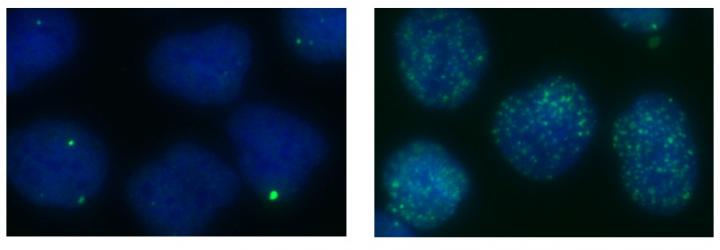
The scientists found that genome instability increases in cells as XPG levels decrease. The green spots mark locations of DNA double-strand breaks. If you have a soft spot for unsung heroes, you'll love a DNA repair protein called XPG. Scientists from the U.S. Department of Energy's Lawrence Berkeley National Laboratory (Berkeley Lab) discovered that XPG plays a previously unknown and critical role helping to maintain genome stability in human cells. Their findings also raise the possibility that the protein helps prevent breast, ovarian, and other cancers associated with defective BRCA genes.

| Molecular & Cell Biology | January 28, 2016 08:54 PM |
| Full story | 0 Comments | 7386 views |

| Biology | January 28, 2016 08:54 PM |
In the brain, the visual cortex processes visual information and passes it from lower to higher areas of the brain. However, information also flows in the opposite direction, e.g. to direct attention to particular stimuli. But how does the brain know which path the information should take? Researchers at the Ernst Strüngmann Institute (ESI) for Neuroscience in Frankfurt in Cooperation with Max Planck Society have now demonstrated that the visual cortex of human subjects uses different frequency channels depending on the direction in which information is being transported. Their findings were only possible thanks to previous research with macaque monkeys. They might help to understand the cause of psychiatric illnesses in which the two channels appear to be mixed up.
| Full story | 0 Comments | 7725 views |
| Molecular & Cell Biology | January 28, 2016 08:54 PM |
It is well known that a predisposition to adiposity lies in our genes. A new study by researchers at the Max Planck Institute of Immunobiology and Epigenetics in Freiburg now shows that it is also crucial how these genes are regulated. The scientists led by Andrew Pospisilik discovered a novel regulatory, epigenetic switch, which causes individuals with identical genetic material, such as monozygotic twins, to either be lean or obese. Interestingly, much like a classical light switch there are only two discrete outcomes -- ON and OFF, or rather obese and not obese -- not continuous increments as with a dimmer. These new insights fundamentally alter our understanding of how epigenetics influences gene outcomes.
| Full story | 0 Comments | 6378 views |

| AIDS & HIV | January 28, 2016 08:54 PM |
HIV drug resistance to tenofovir, an antiretroviral drug vital to most modern HIV treatment and prevention strategies, is surprisingly and worryingly common according to a large study led by UCL (University College London) and funded by the Wellcome Trust.
| Full story | 0 Comments | 31148 views |

- In some genetic cases of microcephaly, stem cells fail to launch
- Yale team discovers how Zika virus causes fetal brain damage
- Scientists uncover the way a common cell enzyme alerts the body to invading bacteria
- Arctic gives clues on worst mass extinction of life
- Calcium channel blockers caught in the act at atomic level
Search Bio News Net
Free Biology Newsletter
- Flexibility That A.C.A. Lent to Work Force Is Threatened by...International Herald Tribune
- Bacteria Behind Legionnaires’ Disease Found at New York Police StationInternational Herald Tribune
- Prescription Price Crisis? 28 Million Americans See Spike in Drug...MSNBC.com: Health
- Seizing on Opioid Crisis, a Drug Maker Lobbies Hard for...International Herald Tribune
- Republicans are taking a big political risk on health careAP Health News
- Why We're So Divided Over Saving WolvesNational Geographic News