

The immune system exercises constant vigilance to protect the body from external threats--including what we eat and drink. A careful balancing act plays out as digested food travels through the intestine. Immune cells must remain alert to protect against harmful pathogens like Salmonella, but their activity also needs to be tempered since an overreaction can lead to too much inflammation and permanent tissue damage.

| Health & Medicine | January 23, 2016 03:39 AM |
One of the most common genetic disorders is a condition called neurofibromatosis, which causes brown spots on the skin and benign tumors on the brain, spinal cord and other parts of the nervous system.
| Full story | 0 Comments | 8865 views |

| Molecular & Cell Biology | January 23, 2016 03:39 AM |
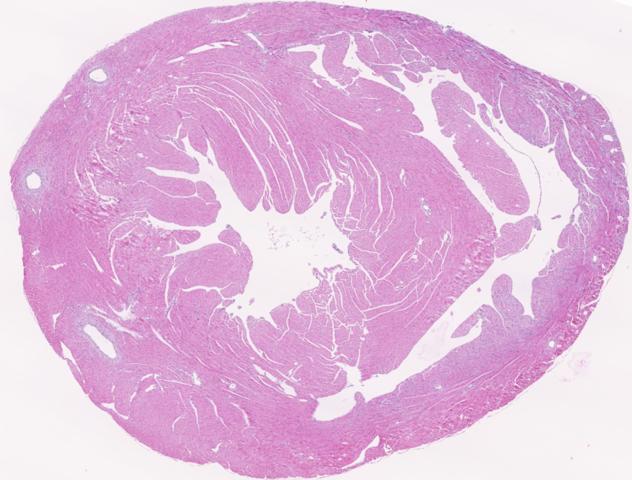
A histological section of a heart. Researchers at the Centro Nacional de Investigaciones Cardiovasculares Carlos III (CNIC) have identified how two proteins control the growth of the heart and its adaptation to high blood pressure (hypertension). Lead investigator Dr. Guadalupe Sabio explains that the results, described in Nature Communications, not only increase our understanding of the mechanisms used by cardiac cells to grow and adapt, but could also help in the design of new strategies to treat heart failure caused by excessive growth of the heart. The study, carried out by Dr. Sabio and CNIC investigator Bárbara Gonzalez-Terán, shows for the first time that two proteins, p38 gamma and p38 delta, control heart growth.
| Full story | 0 Comments | 5783 views |

| Biotechnology | January 23, 2016 03:39 AM |
In a discovery that may lead to ways to prevent frost on airplane parts, condenser coils, and even windshields, a team of researchers led by Virginia Tech has used chemical micropatterns to control the growth of frost caused by condensation.
| Full story | 0 Comments | 7229 views |
| Molecular & Cell Biology | January 23, 2016 03:39 AM |
This meeting will focus on the genetics, biochemistry, and biology of Krüppel-like factors (KLFs) as well as their structurally and functionally related, Specificity Proteins (Sps) along with their impact on human diseases. Significant efforts will be given to discussing the application of KLF/SP-based tools to gene editing and cell-based therapies for regenerative medicine (iPS cells). KLFs/SP proteins constitute a single family of zinc finger-containing transcription factors that exhibit homology to the Drosophila gap gene product, Krüppel. There are at least 18 KLFs and 9 Sp proteins, with a multitude of important functions including regulation of proliferation, differentiation, inflammation/immunity, metabolism, and carcinogenesis. Dysregulation of KLF/SP-mediated pathways contributes to pathological states such as obesity, cancer, and inflammatory conditions. Recent studies indicate that many of these transcription factors have the ability to reprogram somatic cells to inducible pluripotent stem (iPS) cells, and to maintain the pluripotent state of embryonic stem cells; interestingly, several members can substitute for one another in establishing and/or maintaining pluripotency. This transformational discovery has elicited the attention of investigators and medical practitioners from the field of Regenerative Medicine. Molecular insights derived from zinc finger-DNA interactions, which have been derived and most thoroughly validated from work on Sp/KLF proteins has given rise to a new area of research that is growing exponentially, namely gene-editing by artificial KLF-like zinc finger proteins that allow for in vivo gene mutation, mutation repair, deletions, insertion and other type of engineering for both research and medical practice. Thus, the scope and the impact of our 2016 meeting, we will have investigators that discuss the use of Zinc finger nucleases, TALENS, and CAS/CRISPR systems. Lastly, many additional and novel roles for various Sp/KLFs in normal and disease states are only now being fully studied and explored. We expect that through the interaction fostered in this meeting will fuel subsequent collaborations, lead to the design of new diagnostic and therapeutic approaches for broad array diseases. This is truly and international meeting which counts with a confirmed list of speakers from USA, Canada, Europe, and Asia. A large number of oral presentations will be selected from the abstracts, and the selected talks, poster presentations, and recreational activities will provide students and postdoctoral fellows opportunities to exchange ideas and formulate new collaborations.
| Full story | 0 Comments | 5814 views |
| Biotechnology | January 23, 2016 03:39 AM |
Bethesda, MD - Genome engineering is a rapidly growing discipline that seeks to develop new technologies for the precise manipulation of genes and genomes in cellula and in vivo. In addition to its utility for advancing our understanding of basic biology, genome engineering has numerous real-world applications, ranging from correction of disease-causing mutations in humans to engineering plants that better provide fuel, food and industrial raw materials. The first clinical trials and patient treatments using genome engineering approaches are now a reality. The scope of this meeting is expansive, encompassing multiple approaches for modifying genomes - from transgenesis and gene targeting to the creation of synthetic genomes. The experimental models featured include bacteria, fungi, model organisms (e.g.-- Drosophila, C. elegans, zebrafish, mice, rats), plants, humans, and animals including livestock. We anticipate that this diversity of approaches and experimental systems will create a stimulating meeting environment that will enable new insights and advance the field.
| Full story | 0 Comments | 6803 views |

- In some genetic cases of microcephaly, stem cells fail to launch
- Yale team discovers how Zika virus causes fetal brain damage
- Scientists uncover the way a common cell enzyme alerts the body to invading bacteria
- Arctic gives clues on worst mass extinction of life
- Calcium channel blockers caught in the act at atomic level
Search Bio News Net
Free Biology Newsletter
- Flexibility That A.C.A. Lent to Work Force Is Threatened by...International Herald Tribune
- Bacteria Behind Legionnaires’ Disease Found at New York Police StationInternational Herald Tribune
- Prescription Price Crisis? 28 Million Americans See Spike in Drug...MSNBC.com: Health
- Seizing on Opioid Crisis, a Drug Maker Lobbies Hard for...International Herald Tribune
- Republicans are taking a big political risk on health careAP Health News
- Why We're So Divided Over Saving WolvesNational Geographic News