

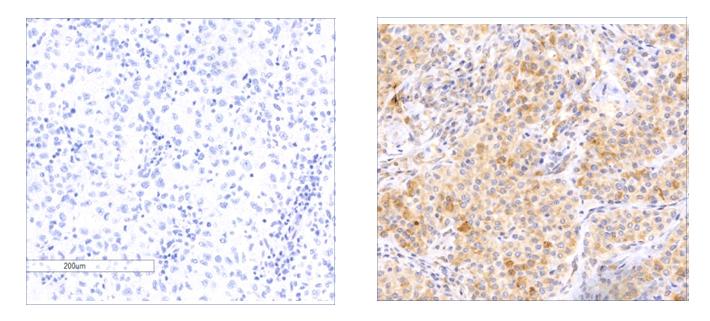
Metastatic melanoma tumors. Left exhibits low or absent expression of RASA2 and reduced survival, typical of about 35 percent of patients. Of the hundreds of genes that can be mutated in a single case of melanoma, only a handful may be true "drivers" of cancer. In research that appeared today in Nature Genetics, a Weizmann Institute of Science team has now revealed one of the drivers of a particularly deadly subset of melanomas - one that is still seeing a rise in new cases. This gene is a newly identified member of a group of genes called tumor suppressor genes. It is mutated in some 5.4% of melanomas. Furthermore, its expression was found to be lost in over 30% of human melanomas; and this loss, according to the finding, was associated with reduced patient survival. This discovery might open new doors to understanding how this cancer grows and spreads, and it may lead in the future to new directions in treating this disease.

| Health & Medicine | November 2, 2015 06:32 PM |
| Full story | 0 Comments | 5361 views |

| Biotechnology | November 2, 2015 06:32 PM |
A team of Massachusetts General Hospital (MGH) investigators has shown that a method they developed to improve the usefulness and precision of the most common form of the gene-editing tools CRISPR-Cas9 RNA-guided nucleases can be applied to Cas9 enzymes from other bacterial sources. In a paper receiving advance online publication in Nature Biotechnology, the team reports evolving a variant of SaCas9 - the Cas9 enzyme from the Streptococcus aureus bacteria - that recognizes a broader range of nucleotide sequences, allowing targeting of genomic sites previously inaccessible to CRISPR-Cas9 technology.
| Full story | 0 Comments | 5179 views |

| Molecular & Cell Biology | November 2, 2015 06:32 PM |
A new discovery published in the Nov. 2015 issue of The FASEB Journal shows that cancer cells use previously unknown channels to communicate with one another and with adjacent non-cancerous cells. Not only does this cast an important light on how cancer metastasizes and recruits cellular material from healthy cells, but it also suggests that these physical channels might be exploitable to deliver drug therapies.
| Full story | 0 Comments | 5469 views |
| Biotechnology | November 2, 2015 06:32 PM |
Researchers at The University of Texas at Austin have developed a nanoscale machine made of DNA that can randomly walk in any direction across bumpy surfaces. Future applications of such a DNA walker might include a cancer detector that could roam the human body searching for cancerous cells and tagging them for medical imaging or drug targeting.
| Full story | 0 Comments | 4993 views |

- In some genetic cases of microcephaly, stem cells fail to launch
- Yale team discovers how Zika virus causes fetal brain damage
- Scientists uncover the way a common cell enzyme alerts the body to invading bacteria
- Arctic gives clues on worst mass extinction of life
- Calcium channel blockers caught in the act at atomic level
Search Bio News Net
Free Biology Newsletter
- Flexibility That A.C.A. Lent to Work Force Is Threatened by...International Herald Tribune
- Bacteria Behind Legionnaires’ Disease Found at New York Police StationInternational Herald Tribune
- Prescription Price Crisis? 28 Million Americans See Spike in Drug...MSNBC.com: Health
- Seizing on Opioid Crisis, a Drug Maker Lobbies Hard for...International Herald Tribune
- Republicans are taking a big political risk on health careAP Health News
- Why We're So Divided Over Saving WolvesNational Geographic News